Belbin team roles
Belbin team roles is a model of nine behaviours a team needs covered, used to talk about who contributes what and where a team has a gap.
Belbin team roles is a model from Meredith Belbin's 1981 book Management Teams that describes nine clusters of behaviour people show at work: Plant, Resource Investigator, Co-ordinator, Shaper, Monitor Evaluator, Teamworker, Implementer, Completer Finisher and Specialist. Belbin argued that a team does best when its work is covered by all of them. Research on that claim is mixed.
- Origin
- R. Meredith Belbin, 1981
- Level
- 301 · Advanced
- Fits
- Startup, Small and mid-size, Scale-up
- Time to apply
- about an hour for a team conversation, once everyone has taken the questionnaire
- What you need
- a team of three to eight people who work on a shared goal · the Belbin questionnaire, or ten minutes per person for a plain-words version of the nine roles · a list of the team's next three big tasks
Belbin team roles is a model of the behaviours a team needs covered to do its work. Meredith Belbin, a British management researcher, developed it from a long study of management teams at Henley Management College and set it out in his 1981 book Management Teams. According to Belbin Associates, the company that sells the questionnaires, the study ran for nine years and found that team success depended more on behaviour than on intellect. The model gives teams a shared vocabulary for who contributes what, and for what is missing.
A role here is a pattern of behaviour, not a job title. A person can be a finance lead by title and a Plant, the idea generator, by behaviour.
The nine roles
The model has nine roles in three groups. The groups below are the ones Belbin Associates uses on its site: social, thinking and task.
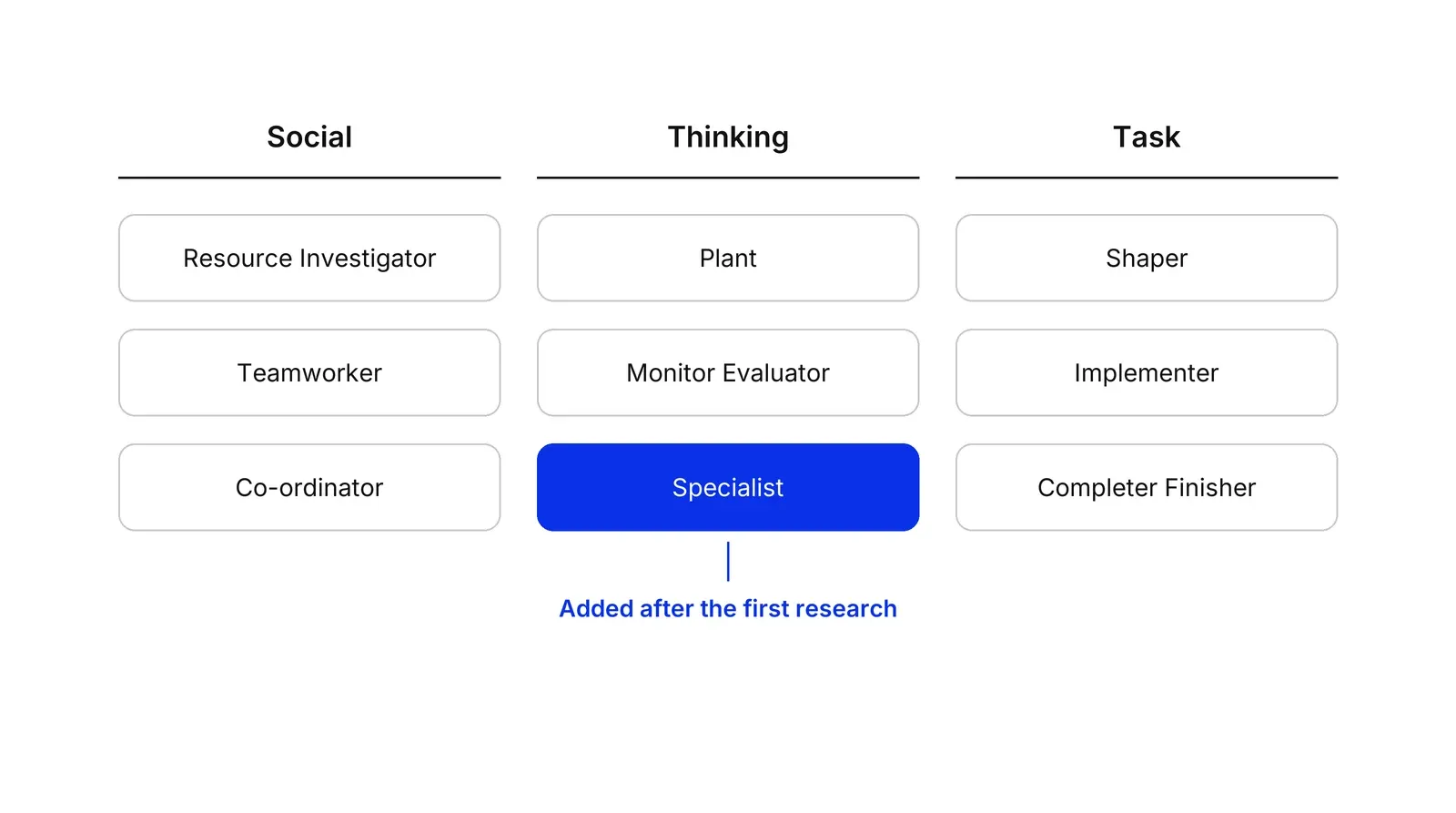
| Role | Group | What it contributes | Allowable weakness |
|---|---|---|---|
| Resource Investigator | Social | Brings outside ideas and contacts | Loses interest once the early excitement fades |
| Teamworker | Social | Helps the team gel | Indecisive under pressure, avoids conflict |
| Co-ordinator | Social | Keeps the team on its objectives | Can seem manipulative, offloads work |
| Plant | Thinking | Solves hard problems creatively | Overlooks details, poor communicator |
| Monitor Evaluator | Thinking | Judges options impartially | Lacks drive to inspire, overly critical |
| Specialist | Thinking | Deep knowledge in one area | Narrow, dwells on technicalities |
| Shaper | Task | Keeps the team moving | Provocative, can offend |
| Implementer | Task | Turns plans into action | Inflexible, slow to adapt |
| Completer Finisher | Task | Checks and polishes work | Worries too much, reluctant to delegate |
The table is Belbin Associates’ own description, paraphrased. The company calls the right-hand column allowable weaknesses: the flip side of each strength that a team can live with.
Where the model came from
Belbin’s team at Henley observed teams in management exercises and added roles one at a time, according to the company’s account. A team made only of Implementers lacked creativity, so Plants were added. Too many Shapers brought in-fighting. The first set had eight roles.
The Specialist came later. Belbin Associates says it emerged once Belbin began applying the research in industry, because the exercises needed no prior knowledge and real work does. The company gives no year. Some secondary pages say 1988, and we found no primary source for that date, so we leave it out. What we can confirm is that a nine-role, 70-item version of the questionnaire existed by the time Furnham, Steele and Pendleton tested it in 1993.
Does a balanced team perform better?
The central claim is that a team covering the roles its work needs performs better than one that does not. Studies of that claim point in different directions, and most are small.
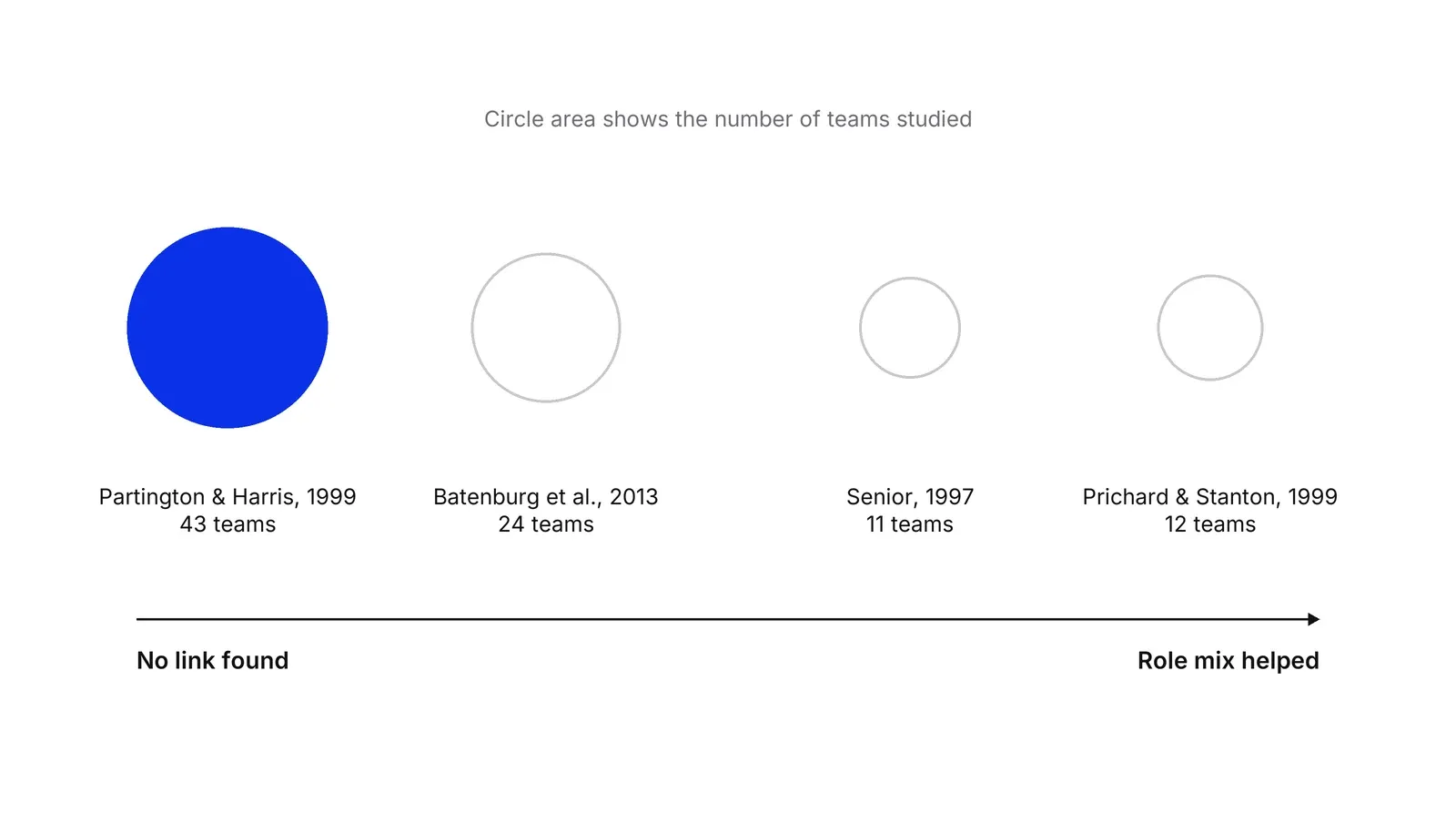
Partington and Harris studied 43 MBA teams in a project simulation and found no significant link between role balance and performance, though the presence or absence of some single roles did matter. Batenburg and colleagues studied 24 student teams in a management game and found no link between role diversity and either the report grade or the financial result. Senior surveyed eleven teams in organisations and found some support for the link. Prichard and Stanton compared six teams of four Shapers with six mixed teams, and the mixed teams did better.
Most of this work uses students or small samples and short tasks. We found no large field study that settles it. Role balance is a reasonable thing to discuss. As a predictor of results it is unproven.
Can the questionnaire be trusted?
The Team Role Self-Perception Inventory is the questionnaire most people mean by the Belbin test. It has been criticised since 1993, when Furnham, Steele and Pendleton reported modest internal consistency and a factor structure that did not clearly match the proposed roles. Belbin replied in the same journal. Fisher, Macrosson and Sharp later reported unsatisfactory test-retest reliability. Broucek and Randell found that the self-report form and the observer form do not work as parallel measures.
Later work was kinder. Swailes and McIntyre-Bhatty argued that earlier reliability estimates were too low, using a sample of 5,003. A 2007 review of 43 studies concluded the model has adequate convergent validity but weak discrimination between some scales. van Dierendonck and Groen tested a revised version with 1,434 people and observer ratings and reported good validity.
Belbin Associates says reliability is good, citing alpha values from .67 to .84. Its FAQ also says the inventory does not have psychometric properties. These are the company’s own claims. A fair summary is that the questionnaire is a conversation starter with known limits, and that observer views add value.
Belbin and other team models
| Model | What it describes | Use it to ask |
|---|---|---|
| Belbin team roles | Who contributes which behaviour | Which contributions does this task need, and who can supply them? |
| Tuckman’s stages | How a team develops over time | Where is this team in its life? |
| Five dysfunctions of a team | What breaks trust and results | Why is this team not performing? |
| Competency model | Skills and behaviours a job needs | What does this role require? |
Belbin sits between a skills list and a team health check. For how to shape a team around its work, see growth team structure. Team composition is one input. Edmondson’s study of 51 work teams found that psychological safety, a shared belief that the team is safe for interpersonal risk, was associated with learning behaviour. Belbin Associates argues the two fit together. We read the evidence as saying that how a team treats its members and what mix it has are separate questions.
How to use it without overclaiming
Use roles to start a conversation about the work, and keep the results in the room. Belbin Associates recommends teams of about four and says nine roles do not mean nine people. Treat any missing role as a prompt to ask who can cover it for this task. A Growth Lab plan starts from the work a team has to do, and a role conversation fits after that, as described under Growth Lab.
How to apply Belbin team roles, step by step
- Name the work first. List the three biggest tasks the team has this quarter, such as launching a payment method or reworking a patient intake flow. Roles only matter against real work. Result: a short list of tasks the conversation is about.
- Collect each person's roles. Each person picks the two or three roles they are most comfortable in, from the questionnaire or from the descriptions. Belbin says most people have two or three preferred roles. Result: a grid with names on one axis and the nine roles on the other.
- Ask observers. Have two or three colleagues say which roles they see each person play. Self-reports are the weakest part of the instrument, so a second view matters. Result: a note of where self-view and colleagues' view differ.
- Match roles to the tasks. For each task, mark which roles it needs most. A new pricing model needs ideas and a critical check. A migration needs follow-through and finishing. Result: each task has the roles it leans on, and any role no one covers is visible.
- Fill gaps by behaviour, not headcount. Ask who can borrow a missing role for a task, or whether a part-time adviser can. Belbin states that nine roles do not need nine people. Result: one named owner for each uncovered role on each task.
- Revisit when the task changes. Roles shift with the work, and people's preferences can change. Run the grid again when the team starts a new type of project. Result: a grid dated and kept next to the team's plan.
Examples
A payments startup product team
Illustrative, no real company implied. Five people build a payout feature: a founder, two engineers, a designer and a compliance lead. The grid shows four people lean on Shaper and Plant, pushing for speed and new ideas, and nobody shows Completer Finisher. The team gives the compliance lead a final check on every release. The numbers here are only a count of preferences, not a measurement of any outcome.
A clinic management team
Illustrative, no real clinic implied. A clinic has a medical director, an operations manager, a head nurse and a marketing lead. The director is the only strong Specialist, and two others tend to defer to that expertise. The group notices that a Monitor Evaluator voice is missing when new service lines are proposed, so it asks a finance adviser to review each proposal before the vote.
When to use it
Use it as a shared vocabulary when a team is new, when work has shifted and the team feels lopsided, or when friction between two people looks like a difference in style. It suits teams of three to eight who work on a common outcome and can talk openly about strengths and gaps.
When not to use it
Do not use it to hire, promote or fire anyone, or to predict whether a team will hit its numbers. The evidence for that is thin, and the self-report questionnaire has known weaknesses. Skip it when the real problem is unclear goals, missing resources or trust, which a role grid will not fix.
Common mistakes
- Treating a questionnaire result as a fixed personality type, when Belbin describes roles as behaviours that can change.
- Hiring one person per role to build the perfect nine. Belbin says nine roles do not mean a team needs nine people.
- Relying on self-report alone. Studies of the inventory raise concerns about reliability and about how separate some scales are.
- Using results in selection. A 2004 study found gender differences on several scales and raised adverse-impact concerns for selection use.
- Ignoring the team's psychological safety. A role grid does not help in a team where people will not say what they think.
FAQ
How many Belbin team roles are there?
Nine: Plant, Resource Investigator, Co-ordinator, Shaper, Monitor Evaluator, Teamworker, Implementer, Completer Finisher and Specialist. Belbin's first research identified eight. The Specialist came later, according to Belbin's own site, which gives no year.
Is the Belbin test scientifically valid?
The evidence is mixed. A 2007 review of 43 studies found adequate convergent validity but weak discrimination between some scales. Early studies found poor reliability. Later work using larger samples found it better than first thought. Belbin Associates says its reliability is good.
Does a team need all nine roles?
Belbin's own guidance says no. People usually hold two or three preferred roles, and not every role must be active at once. What matters is whether the team's current tasks have someone who can play the roles they depend on.
What is the difference between Belbin roles and Tuckman's stages?
Belbin roles describe who contributes what in a team at a given time. Tuckman's stages describe how a team develops over time, from forming to performing. A team can use both: stages to see where the group is, roles to see who does what.
Sources
- Belbin Associates, Belbin Team Roles
- Belbin Associates, History of Belbin
- Belbin Associates, The research
- Belbin Associates, Belbin reliability
- Belbin Associates, Frequently asked questions
- Belbin Associates, Belbin, Project Aristotle and high-performing teams
- Elsevier, Belbin, Management Teams: Why they succeed or fail (3rd ed.)
- Furnham, Steele and Pendleton, A psychometric assessment of the Belbin Team-Role Self-Perception Inventory, Journal of Occupational and Organizational Psychology, 1993
- Belbin, A reply to the Belbin Team-Role Self-Perception Inventory by Furnham, Steele and Pendleton, Journal of Occupational and Organizational Psychology, 1993
- Fisher, Macrosson and Sharp, Further evidence concerning the Belbin Team Role Self-perception Inventory, Personnel Review, 1996
- Broucek and Randell, An assessment of the construct validity of the Belbin Self-Perception Inventory and Observer's Assessment, Journal of Occupational and Organizational Psychology, 1996
- Senior, Team roles and team performance: is there really a link?, Journal of Occupational and Organizational Psychology, 1997
- Partington and Harris, Team role balance and team performance: an empirical study, Journal of Management Development, 1999
- Prichard and Stanton, Testing Belbin's team role theory of effective groups, Journal of Management Development, 1999
- Swailes and McIntyre-Bhatty, The Belbin team role inventory: reinterpreting reliability estimates, Journal of Managerial Psychology, 2002
- Swailes and McIntyre-Bhatty, Scale structure of the Team Role Self Perception Inventory, Journal of Occupational and Organizational Psychology, 2003
- Anderson and Sleap, An evaluation of gender differences on the Belbin Team Role Self-Perception Inventory, Journal of Occupational and Organizational Psychology, 2004
- Swailes and Aritzeta, Scale properties of the Team Role Self-Perception Inventory, International Journal of Selection and Assessment, 2006
- Aritzeta, Swailes and Senior, Belbin's team role model: development, validity and applications for team building, Journal of Management Studies, 2007
- van Dierendonck and Groen, Belbin revisited: a multitrait-multimethod investigation of a team role instrument, European Journal of Work and Organizational Psychology, 2011
- Batenburg, van Walbeek and in der Maur, Belbin role diversity and team performance: is there a relationship?, Journal of Management Development, 2013
- Edmondson, Psychological safety and learning behavior in work teams, Administrative Science Quarterly, 1999
Last updated Oct 9, 2026


Fractional COO or embedded operations team? How to choose at Series A
The two models solve different problems: how to tell which one your company needs, and what each costs in time and control.

What operational systems successful fintech startups use: lessons from ten companies
Starling, Monzo, Qonto, bunq, Lunar, Pleo, Tide, Ramp, Mercury and Column scaled on four operating systems. Regulators' findings show what breaks when one of them lags behind growth.

What a revenue operations manager actually owns
Pipeline definitions, CRM hygiene, forecasting and the handoffs between marketing, sales and success. What the role covers, and how it differs from sales ops.