Kaizen
Kaizen is a management approach in which everyone in the company improves the way work is done through small, continuous changes, starting from a written standard.
Kaizen is the Japanese word for continuous improvement. Masaaki Imai brought it to Western managers in his 1986 book. It asks everyone to make small changes to their own work every day, starting from a standard they then update. Companies also run short kaizen events, but research shows their gains often fade without follow-up.
- Origin
- Masaaki Imai (popularised in the West); rooted in Toyota practice, 1986
- Level
- 301 · Advanced
- Fits
- Small and mid-size, Scale-up, Enterprise
- Time to apply
- One hour to set up a first loop, then a few minutes a day
- What you need
- one process with a written standard, even a half-page checklist · the people who do the work, plus the manager who supports them · a place to log ideas and results where everyone can see them
Kaizen is the practice of improving a process through many small changes, made continuously by the people who do the work. The Lean Enterprise Institute defines it as small, incremental improvements that add up to significant benefits over time. The word is Japanese for continuous improvement. The idea is simple. The hard part is keeping it going, and most of the research on it is about exactly that.
Where does kaizen come from?
Kaizen comes from Japanese manufacturing, above all Toyota, and reached Western managers through Masaaki Imai. His 1986 book, Kaizen: The Key to Japan’s Competitive Success, argued that Japanese firms won through small, ongoing improvements and not through occasional large changes. Mark Graban’s obituary of Imai records his short definition: improvement by everybody, everywhere, every day.
Imai founded the Kaizen Institute in Switzerland in 1985, according to the institute’s own history. His 1997 sequel, Gemba Kaizen, moved the focus to the gemba, the place where the work is done. Publishers Weekly summarises its three steps as an orderly work area, elimination of waste and standardising improvements so they last.
Toyota’s own page treats kaizen as the foundation of its production system: people improve the work itself before machines are built to do it. Steven Spear, in a Harvard Business School interview, describes Toyota’s habit of treating everyday work as an experiment, where workers state what they expect, check what happened and fix problems while details are fresh.
What are the parts of kaizen?
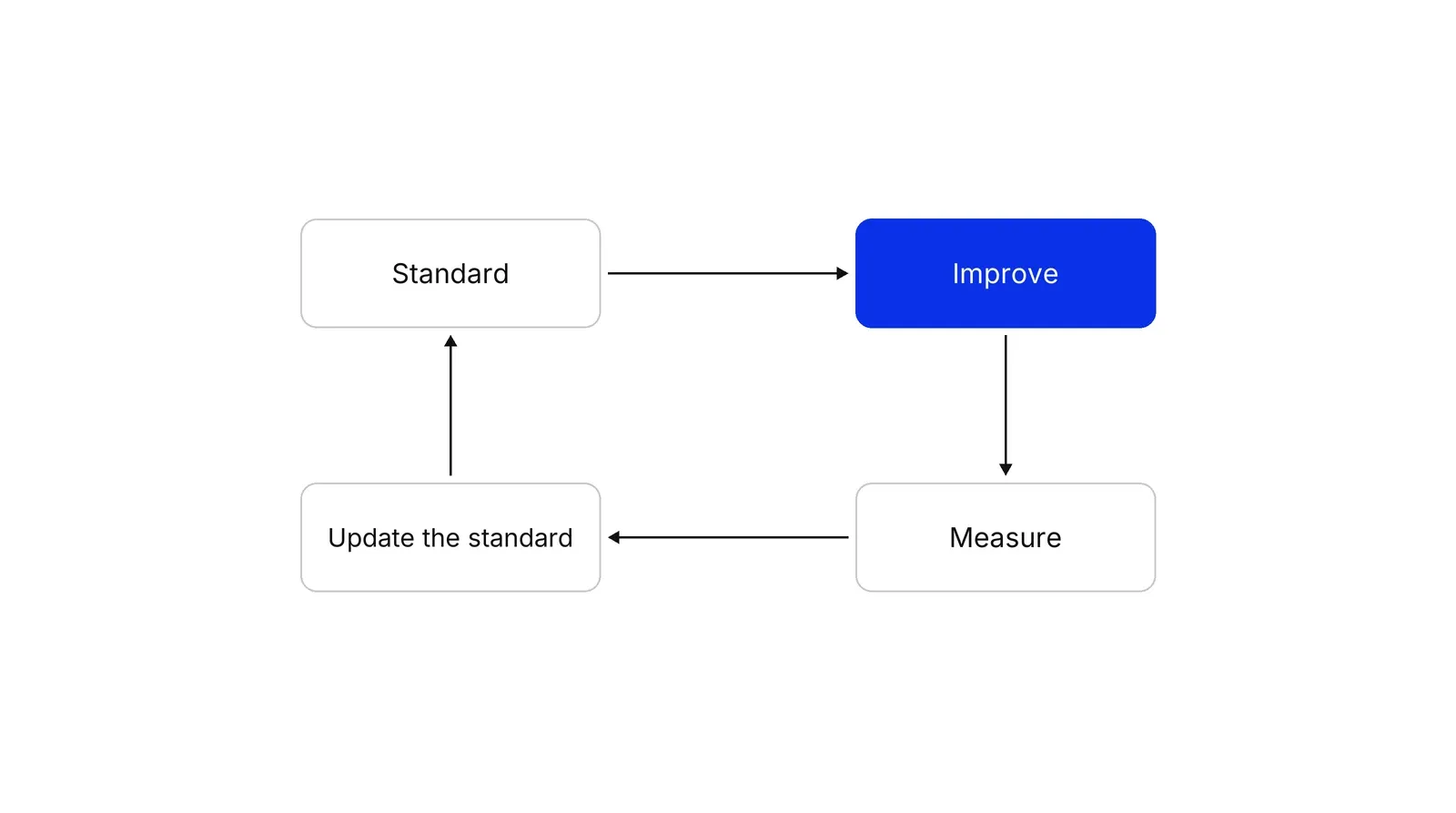
Kaizen has two jobs, which are to hold a standard and to improve it. Graban quotes Imai on this: maintaining and improving the standard is the main task of management. The Lean Enterprise Institute adds Ohno’s rule that there can be no kaizen without a standard, and calls standardized work the baseline that improvement is measured against.
Imai also described three kinds of kaizen, as Graban summarises them. Management-oriented kaizen handles big strategic changes. Group-oriented kaizen lets teams improve a shared process. Individual-oriented kaizen is a person fixing something in their own area, and most of Imai’s material is about this kind.
A practical loop follows from this. Take the standard, try an improvement, measure it and write the better way down. The PDCA cycle is the usual frame for the trial, and the 5 whys is a common way to find the cause before you change anything. A kanban board makes the ideas and their status visible, and a SIPOC shows the process boundaries when people disagree about where a step starts and ends.
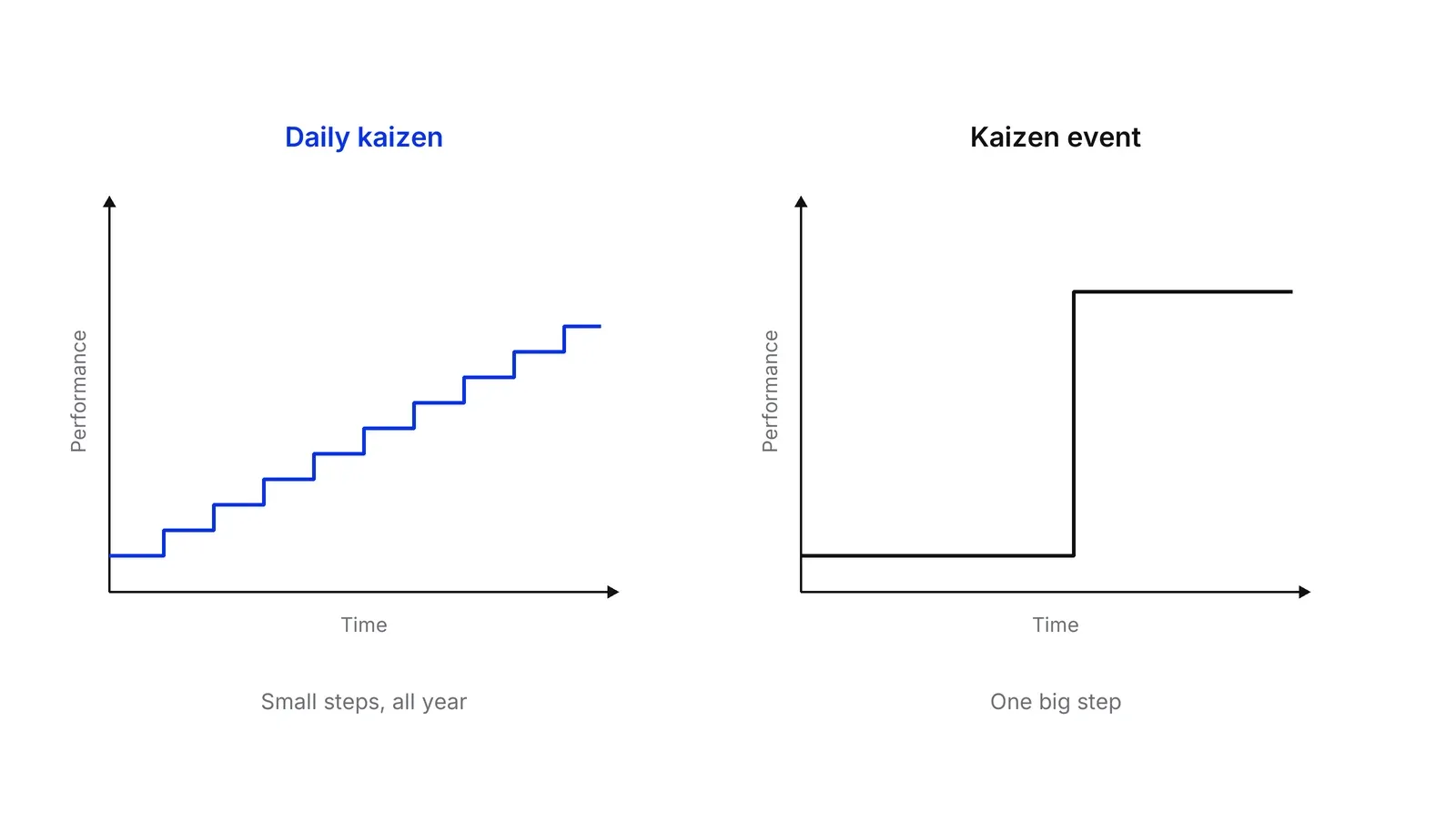
How does daily kaizen differ from a kaizen event?
Daily kaizen is small, frequent change by frontline staff. A kaizen event is a team effort, usually about five days, that makes one significant change. The Lean Enterprise Institute notes that events go by other names, such as kaizen blitz or kaizen workshop, and warns against relying on them alone because daily kaizen is what builds problem solving in frontline staff.
| Daily kaizen | Kaizen event | |
|---|---|---|
| Who | The person doing the work and their supervisor | A cross-functional team |
| Length | Minutes to days | About five days (Lean Enterprise Institute) |
| Size of change | Small, low cost, low risk | One significant change, such as a flow cell |
| Main risk | Ideas that never get tested | Gains fade once the team disperses |
| In Imai’s 1986 book | Yes, the main subject | Not described, per Graban |
The 1999 book The Kaizen Blitz credits the Association for Manufacturing Excellence with developing it, and its authors claim gains of roughly 40 to 50 percent. IndustryWeek’s reporting on early adopters gives company-reported figures, for example about 20 percent yearly productivity gains in most AlliedSignal buildings. These are self-reported and tied to those plants. Graban argues that events can help but are often mismanaged, and suggests calling them kaikaku events, since the LEI defines kaikaku as a sweeping, breakthrough overhaul.
Do the gains from kaizen last?
Often not, unless the organisation plans for it. One research group has studied this in field settings. Farris and colleagues examined 51 events in six manufacturers for the factors behind employee attitudes and problem-solving skills. Doolen and colleagues studied two events in one company and found that positive attitudes at the end of a successful event did not automatically lead to lasting improvement, and that leaders need follow-up mechanisms.
Glover and colleagues followed 65 events in eight manufacturers and surveyed employees at the event and again nine to eighteen months later. In the dissertation behind that paper, two work-area factors, learning and stewardship plus experimentation and continuous improvement, and two post-event factors, performance review and acceptance of changes, predicted several sustainability outcomes. In a later interview study of 16 established event programmes, Glover and colleagues found sustainability was a recurring struggle and that many organisations did not measure important aspects of success, especially the effect on people.
Healthcare shows the same split. In the BMJ Open study of 26 hospital units, 13 sustained their results, 3 could not and 5 struggled to improve at all. A supportive culture and follow-up mattered most, and lack of time was the main cause of decline. A 2025 review by Harry, Van Aken and Glover covers 64 papers on hospital kaizen events and calls for more quantitative work, so the evidence base is still thin.
The pattern across these studies is consistent. Events work as a start, and the habit that follows them decides whether the gain stays. A Growth Lab plan starts from a process with a written standard and a weekly review, so each small change has somewhere to land.
How to apply Kaizen, step by step
- Write down the current standard. Describe how the work is done today, step by step, in a form the team can read in a minute. Ohno's rule, quoted by the Lean Enterprise Institute, is that there is no kaizen without a standard. Result: a baseline to improve against.
- Pick one small problem close to the work. Ask the people doing the job what slows them down, causes rework or annoys customers. Choose something one person or one small team can change within days. Result: a problem small enough to fix without a project.
- Find the cause and try a fix. Trace the problem to a cause with a method such as the 5 whys, then make the smallest change that tests it. Run it as a PDCA cycle: plan, do, check, act. Result: a trial change with a stated expectation.
- Measure the result. Compare the result with what you expected, using a number the team already tracks, such as handling time, errors or waiting. Result: evidence that the change worked, did nothing or made things worse.
- Make the change the new standard. If it worked, update the written standard and tell everyone who does the job. If not, record what you learned. Result: a standard that now includes the gain, so it does not fade.
- Review weekly and repeat. Spend ten minutes a week on what was tried, what stuck and what is next. Leaders attend and remove blockers. Result: a steady rhythm of small changes and a visible record.
Examples
Toyota's suggestion system
A documented case from Toyota Times. Employees note a problem in daily work, find the cause, try an improvement and submit it on a form that a supervisor reviews. In 2023 about 810,000 suggestions came in, roughly 14.4 per person, and the smallest award is 500 yen. The system rewards the effort as well as the saving.
A hospital group in Finland
A documented case from a 2023 BMJ Open study of kaizen events in 26 units of a Finnish hospital system. Thirteen units sustained their results, three could not, and five struggled to improve at all. Units with a supportive work culture and good follow-up kept their gains. Heavy workload and lack of time were the main causes of decline.
A payments support team
Illustrative. A team answers merchant tickets about late payouts. The standard says reply within four working hours. An agent notices that half the replies start by asking for the payout reference, so she adds the reference field to the ticket form. The team times replies for two weeks, sees the first reply shorten, and rewrites the standard. No project was needed.
When to use it
Use it when a process runs every day and the people who run it can see its flaws: support, onboarding, payouts, scheduling, billing, reception. It suits teams that already have a stable way of working and want steady gains in cost, quality, speed or safety without a large investment.
When not to use it
Do not rely on it alone when the process itself is wrong, or when a market shift needs a large change. The Lean Enterprise Institute separates small steps from breakthrough change, which it calls kaikaku. Skip kaizen events if no one will follow up afterwards.
Common mistakes
- Counting events instead of outcomes. The Lean Enterprise Institute lists the number of events as a common wrong metric, in place of safety, cost, quality or delivery.
- Letting specialists do it for the team. The LEI warns that engineers who lead improvement in place of frontline staff weaken the habit.
- Skipping the standard. Without a written baseline, no one can tell whether a change helped, and the old way returns.
- Running an event and walking away. Field studies find that attitudes and results can fade after an event without review and follow-up.
- Treating kaizen as a suggestion box. Ideas need a trial, a measure and an update of the standard, or they stay ideas.
FAQ
What does kaizen mean?
Kaizen is Japanese for continuous improvement. The Lean Enterprise Institute defines it as small, incremental changes to processes that add up to large long-term benefits. Masaaki Imai, who introduced it to Western readers in 1986, summed it up as improvement by everybody, everywhere, every day.
What is the difference between kaizen and a kaizen event?
Daily kaizen is small change made by the people who do the work. A kaizen event, also called a blitz or workshop, is a team effort that typically runs about five days (Lean Enterprise Institute). Imai's 1986 book does not describe events, according to Mark Graban, so the event format is a later addition.
Is kaizen the same as Lean?
No. Lean is a broader management system with several tools. Kaizen is one part of it, the habit of continuous improvement. The Lean Enterprise Institute ties kaizen to PDCA and standardized work, and Toyota treats it as the base of its production system.
Do kaizen results last?
Not automatically. In a study of 65 events in eight manufacturers, Glover and colleagues tracked employee outcomes nine to eighteen months later and found they depended on factors such as performance review. In a Finnish hospital study, 13 of 26 units sustained results.
How is kaizen different from innovation or kaikaku?
Kaizen changes the current way of working in small steps. The Lean Enterprise Institute describes kaikaku as a sweeping overhaul, for example moving equipment over a weekend to create a flow cell. Most organisations need both, and each needs a standard to land in.
Sources
- Lean Enterprise Institute, Kaizen (Lean Lexicon)
- Lean Enterprise Institute, Kaikaku (Lean Lexicon)
- Lean Enterprise Institute, Standardized work (Lean Lexicon)
- Kaizen Institute, History timeline (Masaaki Imai, 1930 to 2023)
- Mark Graban, Reclaiming the word Kaizen, Quality Digest column, LeanBlog, 2011
- Kaizen Institute, History timeline
- Kaizen Institute, The journey of Kaizen Institute
- Masaaki Imai, Gemba Kaizen: A Commonsense, Low-Cost Approach to Management, McGraw-Hill, 1997 (Publishers Weekly record)
- Toyota Times, Imaginative and Creative: Toyota's creative idea suggestion system
- Toyota Motor Corporation, Toyota Production System
- Harvard Business School Working Knowledge, How Toyota turns workers into problem solvers (Steven Spear interview)
- IndustryWeek, Kaizen Blitz
- Laraia, Moody and Hall, The Kaizen Blitz, John Wiley and Sons, 1999 (publisher page)
- Farris, Van Aken, Doolen and Worley, Critical success factors for human resource outcomes in Kaizen events, International Journal of Production Economics 117(1), 2009
- Doolen, Van Aken, Farris, Worley and Huwe, Kaizen events and organizational performance: a field study, International Journal of Productivity and Performance Management 57(8), 2008
- Glover, Farris, Van Aken and Doolen, Critical success factors for the sustainability of Kaizen event human resource outcomes, International Journal of Production Economics 132(2), 2011
- Wiljeana Glover, Critical success factors for sustaining Kaizen event outcomes, Virginia Tech doctoral dissertation
- Glover, Liu, Farris and Van Aken, Characteristics of established kaizen event programs: an empirical study, International Journal of Operations and Production Management 33(9), 2013
- Haapatalo, Reponen and Torkki, Sustainability of performance improvements after 26 kaizen events, BMJ Open 13(8), 2023 (Aalto University record)
- Harry, Van Aken and Glover, An exploration of Kaizen events in hospitals using a systematic literature review and bibliometric analysis, 2025 (Virginia Tech record)
Last updated Oct 9, 2026


Fractional COO or embedded operations team? How to choose at Series A
The two models solve different problems: how to tell which one your company needs, and what each costs in time and control.

What operational systems successful fintech startups use: lessons from ten companies
Starling, Monzo, Qonto, bunq, Lunar, Pleo, Tide, Ramp, Mercury and Column scaled on four operating systems. Regulators' findings show what breaks when one of them lags behind growth.

What a revenue operations manager actually owns
Pipeline definitions, CRM hygiene, forecasting and the handoffs between marketing, sales and success. What the role covers, and how it differs from sales ops.