Cold start problem
The cold start problem is the launch stage of a networked product, when too few users are on it for anyone to get value; Andrew Chen's five-stage model shows how to get past it and what comes after.
The cold start problem is the difficulty of launching a product whose value depends on other users, such as a marketplace or a payments network, when too few people are on it to be useful. Andrew Chen's 2021 book of the same name answers it with five stages: build one small self-sustaining atomic network, reach the tipping point, hit escape velocity, push past the ceiling and defend the moat.
- Origin
- Andrew Chen (The Cold Start Problem); earlier economics of critical mass from Jeffrey Rohlfs, 2021; 1974
- Level
- 401 · Expert
- Fits
- Startup
- Time to apply
- Two hours to place your product on the five stages and name its atomic network; one to three months to prove the first network holds
- What you need
- weekly retention or repeat-use data for each launch market, team or community · a list of the user groups your product connects and which group creates most of the value · one person who can change the product, the launch market and the incentives
The cold start problem is the stage at which a product that depends on other users has too few of them to be useful. A chat app with no contacts, a marketplace with no sellers and a card that no shop accepts all fail for the same reason: early users find nothing, leave, and make the product emptier for the next person. Andrew Chen, a general partner at Andreessen Horowitz who led rider growth at Uber, turned the problem into a book. He says in his announcement that it grew out of nearly two hundred interviews with people at Uber, Airbnb, Slack, Zoom, Dropbox and Tinder, and it came out in late 2021.
Founders and growth leads of marketplaces, social apps, payment networks and collaboration tools use the book as a launch checklist. This page covers Chen’s lifecycle. Pricing between the two sides of a platform and when one platform takes the whole market are covered in platform strategy and network effects.
What are the five stages?
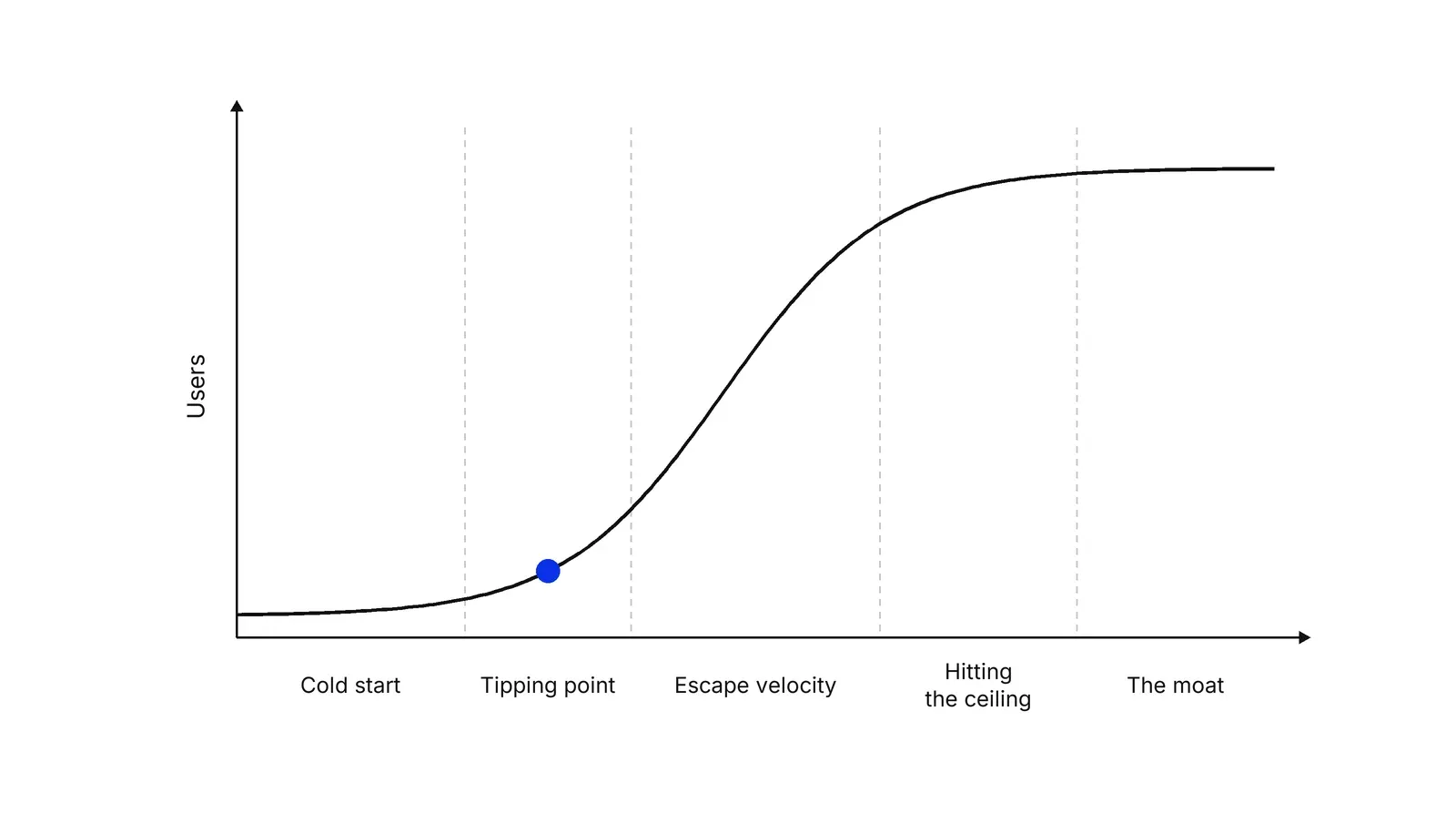
Chen splits the life of a networked product into five stages, summarised in Charter’s briefing on the book. Each one asks a different question, so the first task is to know which stage you are in.
| Stage | The question | What Chen tells you to do |
|---|---|---|
| Cold start | Will new users stay without help? | Build one small atomic network and win its hard side |
| Tipping point | Can you repeat that network? | Copy it market by market with one repeatable tactic |
| Escape velocity | Do network effects make growth cheaper? | Strengthen the acquisition, engagement and economic effects |
| Hitting the ceiling | Why did growth stall? | Fight saturation, channel decay and spam; launch new products |
| The moat | Can a rival take your users? | Defend niches and compete network against network |
Why do small networks shrink?
Small networks shrink because of what Chen calls anti-network effects: when too few people are present, each user gets less value and leaves, as Sachin Rekhi summarises. The answer is an atomic network, defined in the book excerpt on Lenny’s Newsletter as the smallest network that can stand on its own. Its size depends on the product. A Zoom call works with two people, while Airbnb needs hundreds of active listings in a market.
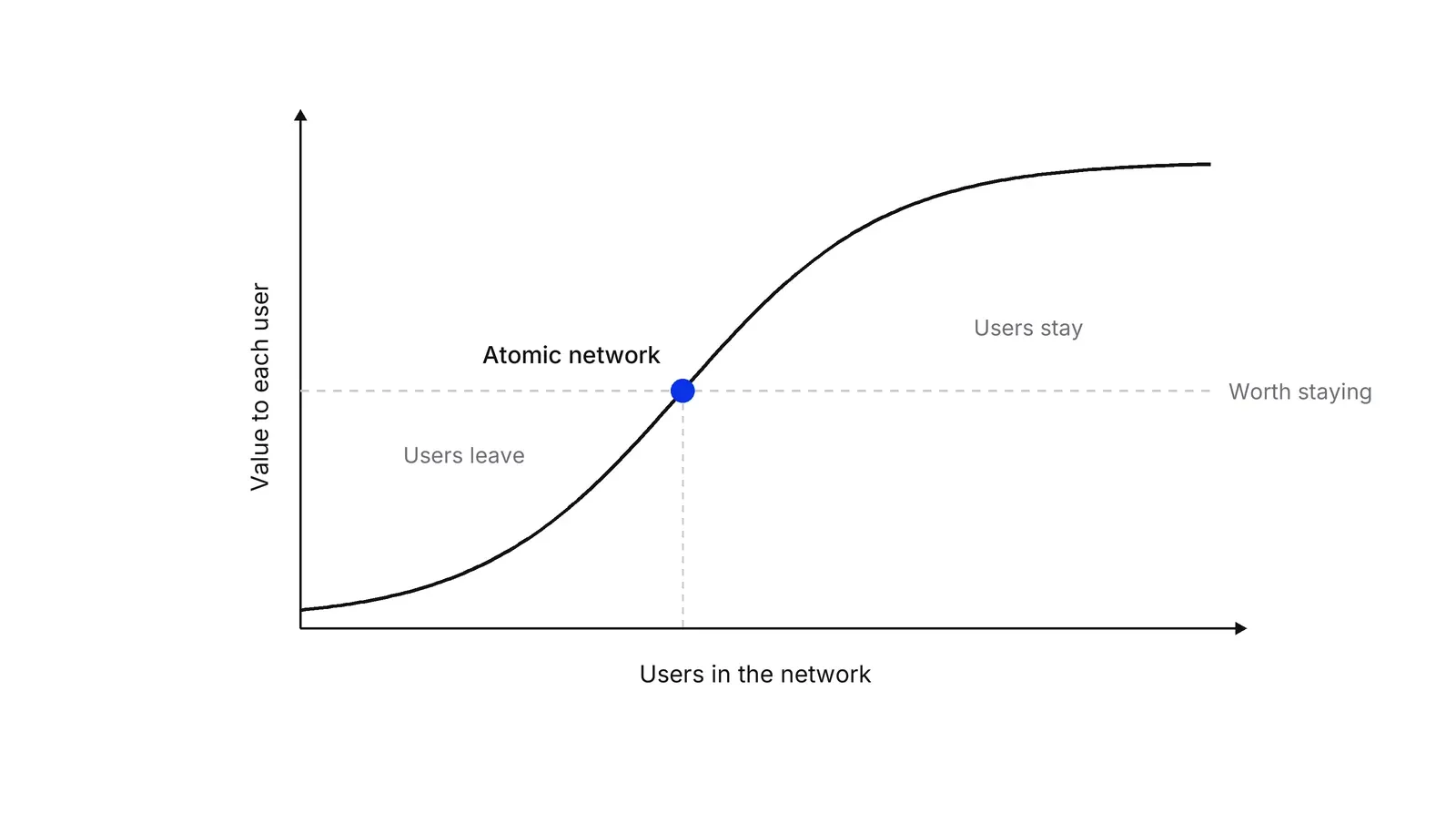
Chen tells teams to find the number at which a network starts to hold. He mentioned two to TechCrunch: Facebook’s “7 friends in 10 days” and Airbnb’s 300 listings with 100 reviewed. Charter adds his Slack figure: teams that exchange about 2,000 messages rarely leave.
The second idea of the stage is the hard side: the minority of users who do most of the work. Per Charter’s summary, about 4,000 Wikipedia editors make a large share of edits, and Uber’s most active drivers handle about 60% of trips. Chen’s advice is to build the first product around what this group needs.
How does a product reach the tipping point?
A product reaches the tipping point when it can repeat its first atomic network in new places, and each new one is easier than the last. Chen lists several repeatable tactics. Invite-only launches give each newcomer friends already inside, as with LinkedIn starting from Reid Hoffman’s network. Chris Dixon’s come for the tool, stay for the network brings people in with a single-user tool, the way Instagram drew users with free photo filters before its feed mattered.
The costlier tactics are money and manual work. Uber at its peak offered more than $50 million a week in US driver incentives, according to Charter. Reddit’s founders used what Chen calls flintstoning, filling gaps by hand until real users take over, a topic he discussed on the a16z podcast. The oldest case in the book is a credit card. In 1958 Bank of America mailed 60,000 cards in Fresno on day one and had 2 million cardholders 13 months later.
What drives escape velocity?
At escape velocity, Chen splits the familiar network effect into three. The acquisition effect means existing users bring in new ones cheaply, as in PayPal’s referral programme. The engagement effect means each user does more as the network fills. The economic effect means conversion and pricing improve with scale, such as teams moving to paid Slack plans as more colleagues join. How to measure the first of these is covered in viral coefficient.
Why does growth hit the ceiling?
Growth stalls even when the product works, and Chen lists the causes: market saturation, weaker marketing channels, early users leaving, and spam, trolls and fraud as the network grows. His law of shitty clickthroughs says every channel decays: the first banner ads on HotWired in 1994 drew a 78% click rate, against 0.05% for Facebook ads in 2011. His fix is new products and markets that start the next curve.
Is a network a moat?
A network is a moat only if a rival would need years and heavy spending to rebuild it, and Chen argues it often protects less than founders assume. Competitors use the same network mechanics. A small attacker takes one niche at a time with its own atomic networks, while an incumbent uses scale, bundling and fast copying. The Slack and Microsoft Teams contest shows the bundling route: Slack complained to the European Commission, and in 2025 Microsoft agreed to sell its Office suites without Teams to settle the case. Scale does not end the fight either; Zhu and Iansiti note that Didi pushed Uber out of China after a long subsidy war.
Where the idea comes from
Economists described the problem decades before the book. Jeffrey Rohlfs’ 1974 paper on telephone-style services discussed “starting up a new communications service”. Katz and Shapiro formalised network externalities in 1985, and Brian Arthur showed in 1989 how early chance events can lock a market in. Caillaud and Jullien named the two-sided version chicken and egg in 2003. Evans and Schmalensee showed in 2010 that a platform usually has to win enough users on both sides at once to take off. Chen’s contribution is a practitioner’s sequence and vocabulary, not a new theory.
The term also has a second meaning. In recommender systems, cold start means an algorithm cannot rate items nobody has reviewed yet, the case Schein and colleagues studied in 2002.
| Chen’s cold start | Recommender cold start | |
|---|---|---|
| What is missing | Users on the network | Ratings or history for one user or item |
| Who solves it | Founders and growth teams | Data scientists |
| Typical fix | One dense atomic network, then repeat | Content features, hybrid models, onboarding questions |
Limits of the model
Reviewers praise the book’s practical tools and fault some of its cases. Tom Sykes, writing in Dialogue Review, notes that Clubhouse has not aged well. Charter points out that network effects are often local: Uber’s lead in New York did not help it in San Diego. Most of the evidence is interviews with successful companies, so the stages work better as a diagnostic than as a law. In Pushers’ Growth Lab the first question for a network product is which atomic network to win, before any channel budget.
How to apply Cold start problem, step by step
- Place the product on the five stages. Ask one question per stage. Do new users stay without your help (cold start)? Can you repeat the first network in a new place (tipping point)? Do the network effects make growth cheaper and use deeper (escape velocity)? Has growth slowed although the product works (ceiling)? Is a rival copying your network (moat)? Result: the one stage you are in, with the evidence.
- Define the atomic network. Write down the smallest unit in which the product works on its own: two people for a video call, one team for a chat tool, one city district for a delivery service. Add a density threshold for it, such as how many sellers a buyer must see. Result: a sentence of the form 'one atomic network is N users of type X in place or group Y'.
- Find the hard side and its magic moment. Name the minority of users who create most of the value: sellers, drivers, editors, hosts. Interview them about what would make them come back daily. Then find the event after which users stay, such as a first match or a first reply. Result: the hard side, what it needs from you and one measurable activation event.
- Choose one tactic to copy the network. Pick the tactic that suits your market: invite-only access, a single-player tool that works before the network exists, subsidies to the hard side, a launch event that fills one place at once, or doing the work by hand until real users take over. Result: one tactic, a cost limit and the second and third atomic networks to launch with it.
- Measure the three network effects. Track acquisition (share of new users who came from existing ones), engagement (use per user as a network fills) and economics (conversion or price as a network grows). Compare young and mature networks side by side. Result: a dashboard that shows which effect is weakening first.
- Plan for the ceiling and the attacker. List what will slow growth next: market saturation, tired marketing channels, spam and fraud, early users leaving. List the niches a smaller rival could take from you. Result: a next product or market for the next growth curve and a defence plan for the niches most at risk.
Examples
BankAmericard in Fresno, 1958
Bank of America mailed 60,000 credit cards to Fresno residents on the first day, so cardholders existed before most shops took the card. More than 300 merchants signed up at launch, and after 13 months the bank had issued 2 million cards and signed 20,000 merchants, according to an a16z account. One city was the atomic network; the bank seeded the side it could reach itself, then recruited the other.
Tinder at the University of Southern California
Tinder's early invites to friends did not keep users, because too few people near each other were on the app. The founders then sponsored a USC party that required the app for entry, and co-founder Sean Rad credits the roughly 500 attendees with helping Tinder take over the campus, as Chen told TechCrunch. One campus held enough single people at the same time and place to form a network.
A physiotherapy booking app in one district (illustrative)
Take a booking app that wants patients to find a session within 48 hours. Each physiotherapist opens 10 slots a week, and one district produces 40 requests a week. With 3 physiotherapists, 30 slots meet 40 requests and a quarter of patients go unserved; with 6, 60 slots cover every request with room for peaks. The atomic network is about six physiotherapists in one district, so the team recruits them first and opens the next district only when this one fills two-thirds of its slots.
When to use it
Use the five stages when the product's value depends on other users: marketplaces, social and messaging apps, payment networks, collaboration tools, booking platforms and communities. The model is most useful before launch and in the first year, when choosing the first market and the side to recruit first matters more than any channel plan.
When not to use it
Skip it for products that work fully for a single user with no network, such as a calculator app, a one-off service or most B2B software sold seat by seat with no sharing. For those, product-market fit and channel tests answer the same questions with less effort. It also says little about pricing between two sides; use a platform pricing analysis for that.
Common mistakes
- Launching everywhere at once. Thin coverage across many markets gives every user an empty product; one dense market beats ten sparse ones.
- Recruiting the easy side first. Buyers sign up readily, but without sellers, drivers or hosts they meet an empty shelf and do not return.
- Reading total sign-ups instead of per-network retention, which hides that each new network fails the same way the first one did.
- Paying subsidies after the network should stand alone. Incentives are a bridge to the tipping point, not a permanent cost of supply.
- Treating a large network as a moat. A rival can take one niche at a time, and network effects are often local to a city or a group.
FAQ
What is the cold start problem?
It is the difficulty of launching a product whose value comes from other users. With few users, nobody finds a match, a reply or a seller, so early users leave, which makes the product emptier still. Andrew Chen named his 2021 book after it and argues that the fix is one small, dense network that holds on its own.
What are the five stages of the cold start theory?
Andrew Chen describes five: the cold start problem, the tipping point, escape velocity, hitting the ceiling and the moat. A product first builds one network that holds, then copies it until the market tips, then strengthens its network effects, then restarts growth when it stalls, and finally defends its networks against rivals.
What is an atomic network?
An atomic network is the smallest network that can stand on its own, with enough users and activity that they keep coming back without outside help. Its size depends on the product: two people for a video call, one team for a work chat, hundreds of listings in one city for a rental marketplace.
What is the hard side of a network?
The hard side is the smaller group of users who do most of the work and create most of the value, so they are the hardest to attract and keep. Examples include drivers in ride-hailing, editors on Wikipedia and sellers on a marketplace. Chen advises building the product around this group first.
Is it the same cold start problem as in recommender systems?
No. In recommender systems, cold start means the algorithm has no ratings or history for a new user or a new item, so it cannot make good suggestions. Chen's cold start problem is about a whole product lacking users. The two meet in marketplaces, where both can happen at launch.
Sources
- Andrew Chen, My first book, The Cold Start Problem, andrewchen.com, 2021
- Andreessen Horowitz, The Cold Start Problem (book page)
- Penguin Random House UK, The Cold Start Problem by Andrew Chen (paperback listing)
- Andrew Chen, The atomic network (book excerpt), Lenny's Newsletter, 2021
- TechCrunch, Andrew Chen of a16z on how startups get past a cold start to survive and thrive, 2021
- a16z Podcast, Kickstarting network effects, with Andrew Chen, Alexis Ohanian and Paul Davison, 2021
- Andrew Chen, The law of shitty clickthroughs, andrewchen.com, 2012
- Chris Dixon, Come for the tool, stay for the network, 2015
- Charter, book briefing: The Cold Start Problem by Andrew Chen
- Tom Sykes, Starting from cold (review), Dialogue Review
- Sachin Rekhi, A primer on network effects from Andrew Chen's The Cold Start Problem
- Alex Rampell, The Fresno free-for-all behind the original credit card, a16z, 2019
- Jeffrey Rohlfs, A Theory of Interdependent Demand for a Communications Service, Bell Journal of Economics 5(1), 1974
- Richard Schmalensee, Jeffrey Rohlfs' 1974 Model of Facebook: An Introduction, MIT Sloan Working Paper 4893-11, 2011
- Michael L. Katz, Carl Shapiro, Network Externalities, Competition, and Compatibility, American Economic Review 75(3), 1985
- W. Brian Arthur, Competing Technologies, Increasing Returns, and Lock-In by Historical Events, Economic Journal 99(394), 1989
- Bernard Caillaud, Bruno Jullien, Chicken & Egg: Competition among Intermediation Service Providers, RAND Journal of Economics 34(2), 2003
- Jean-Charles Rochet, Jean Tirole, Platform Competition in Two-Sided Markets, Journal of the European Economic Association 1(4), 2003
- David S. Evans, Richard Schmalensee, Failure to Launch: Critical Mass in Platform Businesses, Review of Network Economics 9(4), 2010
- Harvard Business Review, Thomas Eisenmann, Geoffrey Parker, Marshall Van Alstyne, Strategies for Two-Sided Markets, 2006
- Harvard Business Review, Andrei Hagiu, Simon Rothman, Network Effects Aren't Enough, 2016
- Harvard Business Review, Feng Zhu, Marco Iansiti, Why Some Platforms Thrive and Others Don't, 2019
- Associated Press, Microsoft resolves European Union probe into Teams, 2025
- Andrew I. Schein, Alexandrin Popescul, Lyle H. Ungar, David M. Pennock, Methods and Metrics for Cold-Start Recommendations, SIGIR 2002
Last updated Oct 9, 2026


Marketing agency or growth system: when a company outgrows its agency
An agency is the right call while the founder still runs most of the company. Once the business starts copying itself into new locations or markets, it needs a system that sets goals, tests hypotheses and owns the result.

Why healthcare marketing agencies stall: the short, mid and long wins model we use with clinics
Most agencies own the click and nobody owns the front desk. How we structure clinic work in three horizons, the research behind each one, and one year of results.

Why channel tests stall after month three
Most paid channel tests do not end with a decision. They end when the budget runs out, the attribution model changes, or everyone quietly stops looking at the dashboard.