Growth team structure
Growth team structure is how a company organizes the people who work on growth: who they report to, what they own and which skills sit on the team.
Growth team structure is the way a company organizes the people responsible for growth: whether they report to a dedicated head of growth or stay in their home functions, how much of the product and marketing they own, and which skills each pod contains. The two common models are independent, reporting to the CEO, and functional, drawn from product, marketing and data.
- Origin
- Practitioner essays: Sean Ellis, Brian Balfour, Andrew Chen; Reforge, 2010 onwards
- Level
- 401 · Expert
- Fits
- Scale-up
- Time to apply
- a half-day workshop to choose a first model, then a review every two quarters
- What you need
- one metric the growth team is accountable for, agreed with the CEO · a list of growth levers (onboarding, SEO, paid, email, referral, pricing) and who owns each today · at least one engineer who can ship experiments without waiting for the core roadmap
Growth team structure is the way a company organizes the people who work on growth. It answers three questions: who those people report to, which parts of the product and marketing they are allowed to change, and which skills sit together on one team.
Sean Ellis coined the term “growth hacker” in a 2010 blog post, describing someone whose “true north is growth”. Brian Balfour, who led growth at HubSpot and later founded Reforge, said on Intercom’s podcast in 2015 that naming a single growth hacker is a recipe for failure, because the work needs engineering, product, design and marketing skills at once.
Why companies create a growth team at all
Onboarding belongs to product, email to lifecycle marketing, paid channels to performance marketing, pricing to finance. Ellis put it plainly in a SaaStr talk: the hard part is coordinating those efforts across all of those teams.
Paul Blase and Paul Leinwand of PwC wrote in Harvard Business Review that most operating models promote silos around marketing, sales and pricing, and that growth needs outcome-oriented, cross-functional teams instead.
Independent vs functional: the two main models
The independent model gives growth its own leader, usually reporting to the CEO, with pods underneath. The functional model leaves growth people in their home departments and groups them into a pod for the work. A study of 20 growth leaders summarised by Amplitude named Uber and Facebook as independent and Pinterest, Twitter, LinkedIn and Dropbox as functional.
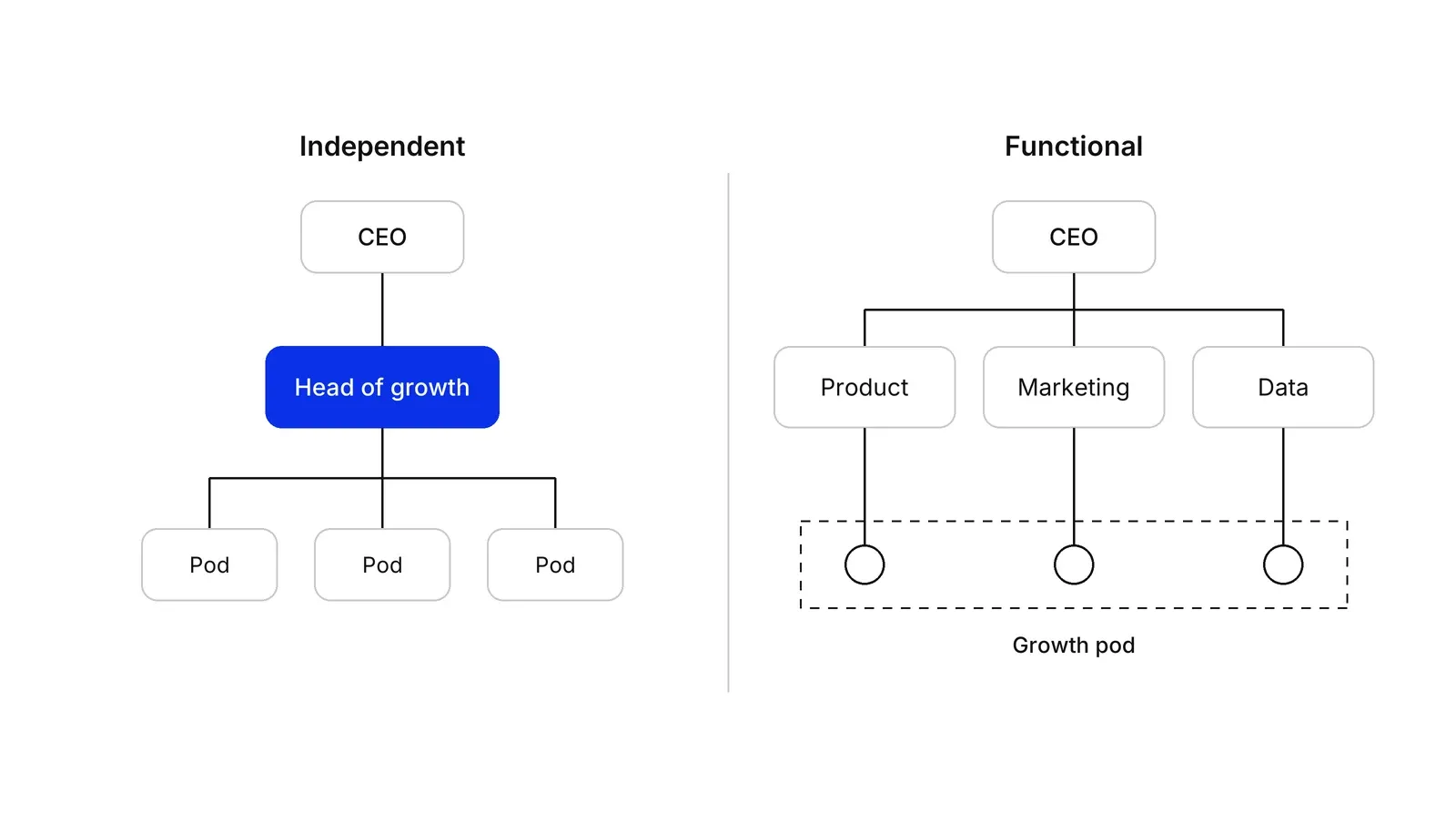
Chen, Reforge and Amplitude name the same split differently:
| Source | Growth has its own leader | Growth people stay in their functions |
|---|---|---|
| Amplitude summary of 20 growth leaders | Independent | Functional |
| Andrew Chen | Business unit (functions report to a GM) | Pods, matrixed into each function |
| Reforge | Centralized | Decentralized, embedded or “tiger” team |
| Main gain | Speed, fewer sideways decisions | Growth thinking spreads across the company |
| Main risk | Silos and fights over who owns what | Slower, because people have other work |
Reforge frames the choice as velocity versus culture. Elena Verna, ex-SVP of Growth at SurveyMonkey, once moved a centralized team to a decentralized one for a few quarters to spread the growth mindset to the rest of the product team. Adam Fishman, also quoted there, says the structure is never fixed.
How much should a growth team own?
Chen describes ownership as a spectrum. At one end, “growth as a service” owns no feature or codebase and changes other teams’ surfaces with their consent. At the other end, the team fully owns areas such as the new user funnel, notifications and ad tech.
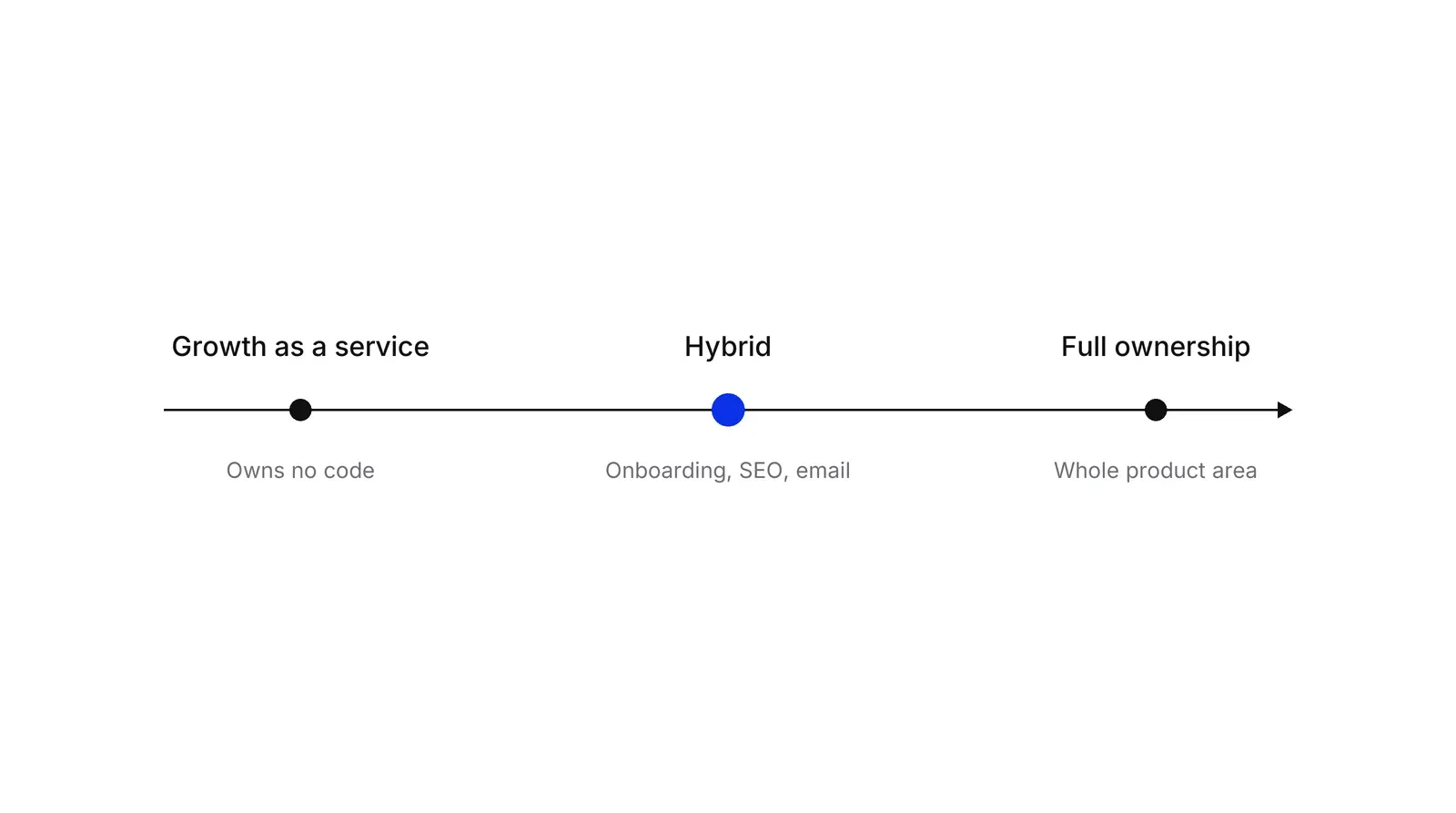
Balfour’s 2015 list maps onto the same line. Early companies run a small SWAT team that moves to wherever the biggest friction is; it stays fast and avoids technical debt but keeps crossing ownership lines. The hybrid owns quantitative marketing, such as high-scale SEO and email, plus product areas like onboarding, referral and virality. Large consumer companies such as Facebook and Uber, he said, gave growth full ownership of whole product areas.
Chen notes that brand ends up in marketing and onboarding usually goes to growth, while SEO, paid and email can sit on either side. Facebook kept performance marketing in growth; Uber started that way and later moved it all into marketing. At Airbnb, Lenny Rachitsky told Greylock, performance marketing was simply one team inside guest growth or host growth.
Who sits on a growth squad
A growth squad, or pod, is a small cross-functional team with one metric. The word squad comes from product organization design: Henrik Kniberg and Anders Ivarsson’s 2012 paper on Spotify describes a squad as a team that feels like a mini-startup, with all the skills needed to design, build, test and release, and a long-term mission.
Chen, who joined Uber’s growth team when it had grown past 500 people at its peak, lists the usual roles: a growth PM who owns the experiment roadmap, growth engineers, a growth marketer with channel expertise, an analyst and a designer who works fast. Ed Baker’s first Uber growth team had five people, one per function, according to a Growth.Talent summary of his account. Chen’s deck says a new-user-experience pod leans on engineers, while an SEO pod needs an SEO marketer, data and a full-stack web engineer.
At SaaStr Annual 2016 Ellis suggested one dedicated growth lead and an ad hoc team of designers, engineers and analysts, with the heads of product and engineering and the CEO joining a weekly growth meeting. Ideas are scored 1 to 10 with ICE; his GrowthHackers team kept over 700 untested ideas in its backlog, and he cited Twitter’s rebound after it raised testing to about 10 tests a week. That cadence is what a company-wide experimentation program later formalizes.
Growth teams in product-led companies
Product-led growth (PLG) is a go-to-market model in which, in Blake Bartlett’s words to Sacra, the product itself is the primary driver of acquisition, conversion and expansion. Bartlett says OpenView coined the term in 2016.
In PLG companies such as Atlassian, Datadog or Snowflake, which Bartlett names, sign-up, onboarding and upgrade prompts live inside the product. By Chen’s map those surfaces usually belong to growth, so PLG growth teams sit close to product. We found no primary source that prescribes one PLG team model. The open question is the hand-off to sales: Verna describes product-led sales as an escalator out of self-serve into sales, and Stephanie Kwok proposes a GM structure that pairs accountability for results with control of the growth levers (Reforge, 2022).
What the research says
No peer-reviewed study compares independent and functional teams on results. Bohnsack and Liesner’s 2019 taxonomy in Business Horizons breaks growth hacking into marketing, data analysis, coding and the lean startup approach, and lists 34 patterns across acquisition, activation, revenue, retention and referral. Troisi and colleagues studied three B2B firms through action research. Conway and Hemphill’s interviews with UK start-up practitioners found it very difficult to hire one person with the full skill set.
Set the metric before the org chart: first the number the team owns, then the reporting line. A Growth Lab plan starts from that metric.
How to apply Growth team structure, step by step
- Name the problem the team exists to solve. Write down the metric that is stuck and where it is stuck: sign-up to activation, trial to paid, or month-two retention. A team created to fix activation needs different people than one created to grow SEO traffic. Result: one metric and one funnel stage written at the top of the team charter.
- Map who owns each growth lever today. List every lever that moves the metric, such as onboarding screens, notifications, paid channels, SEO, email and referral, and write the team that owns each one. Brand almost always stays in marketing. Result: a two-column table of levers and owners, with the gaps and overlaps marked.
- Choose independent or functional reporting. Pick independent if growth needs fast decisions across many owners and the CEO will back one head of growth. Pick functional if the work is mostly inside the product and the heads of product, engineering and data will lend people. Result: a one-page org chart showing who each growth person reports to.
- Decide how much the team owns. Place the team on the ownership spectrum: growth as a service that changes other teams' code with permission, a hybrid that owns onboarding and quantitative channels, or full ownership of a product area. Result: a short list of surfaces the team may change without asking.
- Staff the first pod. Start with a growth lead, one or two engineers, a designer part-time and an analyst, plus a marketer if channels are in scope. Agree a weekly growth meeting where ideas are scored and tests are reviewed. Result: named people, a meeting slot and a backlog with the first ten scored ideas.
- Review the structure every two quarters. Check whether the metric moved, how many tests shipped, and where the team collided with other owners. Move levers in or out of the team based on that record. Result: a short note that keeps or changes the model, with the reason.
Examples
Uber: an independent team that grew
Andrew Chen, who worked on Uber's growth team, writes that Ed Baker founded it. 20VC lists Baker as Uber's VP of product and growth from 2013 to 2017. Chen says the team began as a business-unit-style group and took on ownership of product areas over time, reaching more than 500 people at its peak including China Growth. A Growth.Talent summary of Baker's account says the first five people covered product, design, engineering, marketing and data science, the team reported to the CEO, and it worked toward one north star metric, weekly trips. Chen also notes that Uber first kept paid marketing in growth and later moved it all into marketing.
Airbnb: marketing inside growth teams
Lenny Rachitsky, a former growth lead at Airbnb, described in a 2019 Greylock discussion how the company split growth into guest growth and host growth. Performance marketing was not a separate department: it was one team inside guest growth or host growth, led by a product manager, with marketers, data scientists and engineers on it.
A payments company choosing a functional pod
Illustrative, no real company implied. A B2B payments startup with 60 staff sees about a thousand sign-ups a month but only a quarter of them complete verification. It cannot hire a head of growth yet, so the head of product lends a PM and an engineer, the data lead lends an analyst two days a week, and marketing lends a lifecycle marketer. The four meet weekly and own one metric: the share of sign-ups that finish verification within seven days. Each person still reports to their own function.
When to use it
Use it when growth work keeps stalling between product and marketing, when a key metric such as activation or retention has no single owner, or when a company past product-market fit is about to hire its first head of growth and needs to decide what that person will run.
When not to use it
Skip it before product-market fit, when users are not yet coming back on their own and no structure will fix that. It also adds little in a company of fewer than about ten people, where one or two people working with the CEO already cover the growth work.
Common mistakes
- Hiring one growth hacker and expecting results. Brian Balfour called a single person with that title a recipe for failure; the work needs engineering, product, design and marketing skills.
- Creating a growth team without deciding what it owns, so every test needs permission from another team and nothing ships.
- Copying the structure from a previous company. Reforge quotes Elena Verna warning that this is the fastest way to fail.
- Giving the team three metrics. A pod with one north star metric can say no to work; a pod with three cannot.
- Treating the structure as permanent. Uber started with paid marketing inside growth and later moved it all into marketing as it scaled.
FAQ
What is the difference between an independent and a functional growth team?
In an independent team, growth people report to a head of growth who reports to the CEO, as at Uber and Facebook. In a functional team, they stay in product, engineering, marketing or data and work together as a pod. Independent teams move faster across owners; functional teams spread growth thinking but share people with other work.
Who should a growth team report to?
There is no single answer. Uber's and Facebook's growth teams reported to the CEO, while companies such as Pinterest, Dropbox and LinkedIn placed growth under product, according to a study summarised by Amplitude. Elena Verna argues the reporting line matters less than whether the team works together in pods.
What roles does a growth team need?
Andrew Chen lists five: a growth product manager who owns the experiment roadmap, growth engineers, a growth marketer with channel expertise, a data analyst and a designer who works fast. Brian Balfour says a team can start with two or three people as long as those skills are covered.
When should a startup build a growth team?
After it has product-market fit and some organic growth. Andy Johns, who worked on growth at Facebook, Twitter and Wealthfront, advises building the team after you demonstrate organic growth and a receptive market. Before that, a growth team optimizes a funnel that leaks because the product is not yet working.
How is a growth team different from a marketing team?
Marketing usually owns brand, positioning and campaigns. A growth team owns a metric and works across product and channels to move it, running experiments on onboarding, notifications, referral and pricing as well as paid and SEO. Andrew Chen notes that brand almost always stays in marketing, while onboarding usually goes to growth.
Sources
- Sean Ellis, Find a Growth Hacker for Your Startup, Startup-Marketing.com, 2010
- Andrew Chen, Growth Hacker is the new VP Marketing, andrewchen.com, 2012
- Penguin Random House, Hacking Growth by Sean Ellis and Morgan Brown, 2017
- SaaStr, Sean Ellis on building a company-wide growth culture, SaaStr Annual 2016 transcript
- Intercom, Brian Balfour on creating meaningful growth, podcast, October 2015
- Brian Balfour, Building a growth machine
- Andrew Chen, How to build a growth team: lessons from Uber, Hubspot, and others
- Andrew Chen, What does a growth team work on day to day?
- Amplitude, Alicia Shiu, How to Structure your Growth Team, December 2016
- Reforge, Growth team structure
- Reforge, How to Build an Impactful Growth Team in 4 Steps, February 2023
- Reforge, Reforge partners' thoughts on product, growth and marketing, May 2022
- Miro, Elena Verna, Growth team structure template
- Greylock, Lessons learned growing successful marketplaces (Lenny Rachitsky), December 2019
- 20VC, 20Growth: Five key functions of a growth team, with Ed Baker, February 2022
- Growth.Talent, Ed Baker on the five functions every growth team needs to scale
- First Round Review, Andy Johns, Indispensable growth frameworks from my years at Facebook, Twitter and Wealthfront, 2015
- Built In, Mae Rice, Casey Winters on what startups mean by growth, April 2020
- Henrik Kniberg, Anders Ivarsson, Scaling Agile @ Spotify with Tribes, Squads, Chapters & Guilds, October 2012
- Sacra, Blake Bartlett of OpenView on the future of product-led growth, June 2023
- Paul Blase, Paul Leinwand, Create a System to Grow Consistently, Harvard Business Review, March-April 2024
- René Bohnsack, Meike Malena Liesner, What the hack? A growth hacking taxonomy and practical applications for firms, Business Horizons 62(6), 2019
- Orlando Troisi, Gennaro Maione, Mara Grimaldi, Francesca Loia, Growth hacking: Insights on data-driven decision-making from three firms, Industrial Marketing Management, 2020
- Lisa Conway, Thomas Hemphill, Growth hacking as an approach to producing growth amongst UK technology start-ups, Journal of Research in Marketing and Entrepreneurship, 2019
Last updated Oct 9, 2026


Marketing agency or growth system: when a company outgrows its agency
An agency is the right call while the founder still runs most of the company. Once the business starts copying itself into new locations or markets, it needs a system that sets goals, tests hypotheses and owns the result.

Why healthcare marketing agencies stall: the short, mid and long wins model we use with clinics
Most agencies own the click and nobody owns the front desk. How we structure clinic work in three horizons, the research behind each one, and one year of results.

Why channel tests stall after month three
Most paid channel tests do not end with a decision. They end when the budget runs out, the attribution model changes, or everyone quietly stops looking at the dashboard.