Working Backwards (PR/FAQ)
Working Backwards is Amazon's method of writing the launch press release and a list of hard questions for a product before building it, so weak ideas die on paper and strong ones start with a clear customer.
Working Backwards is a product-development method from Amazon in which a team writes the future launch press release and a frequently asked questions document (the PR/FAQ) before any building starts. The press release forces a clear customer, problem and benefit. The FAQ forces honest answers on price, economics and risk, so leaders can say go or no-go early.
- Origin
- Amazon; described by Colin Bryar and Bill Carr, 2004 (per the authors); book 2021
- Level
- 401 · Expert
- Fits
- Startup, Scale-up, Enterprise
- Time to apply
- two to three days for a first draft, then several rounds of review over a few weeks
- What you need
- one named author who owns the idea · what you know about the customer, in their words, not survey averages · two or three reviewers who will argue with the draft
Working Backwards is a product-development method from Amazon in which a team writes the launch press release, and a document of hard questions about it, before building anything. The pair is called the PR/FAQ. Colin Bryar and Bill Carr, two former senior Amazon executives, set the method out in their 2021 book Working Backwards. They write that most of Amazon’s major products and initiatives since 2004 were created this way. Amazon’s leadership principles compress the idea into one line: leaders start with the customer and work backwards.
Why write the press release first?
A press release forces you to say who the product is for, what problem it solves and why anyone would care, in words a customer could read. Werner Vogels, Amazon’s chief technology officer, explained the logic in a 2006 blog post: writing a press release up front clarifies how the world will see the product. His version has four steps: the press release, an FAQ, the customer experience and a user manual.
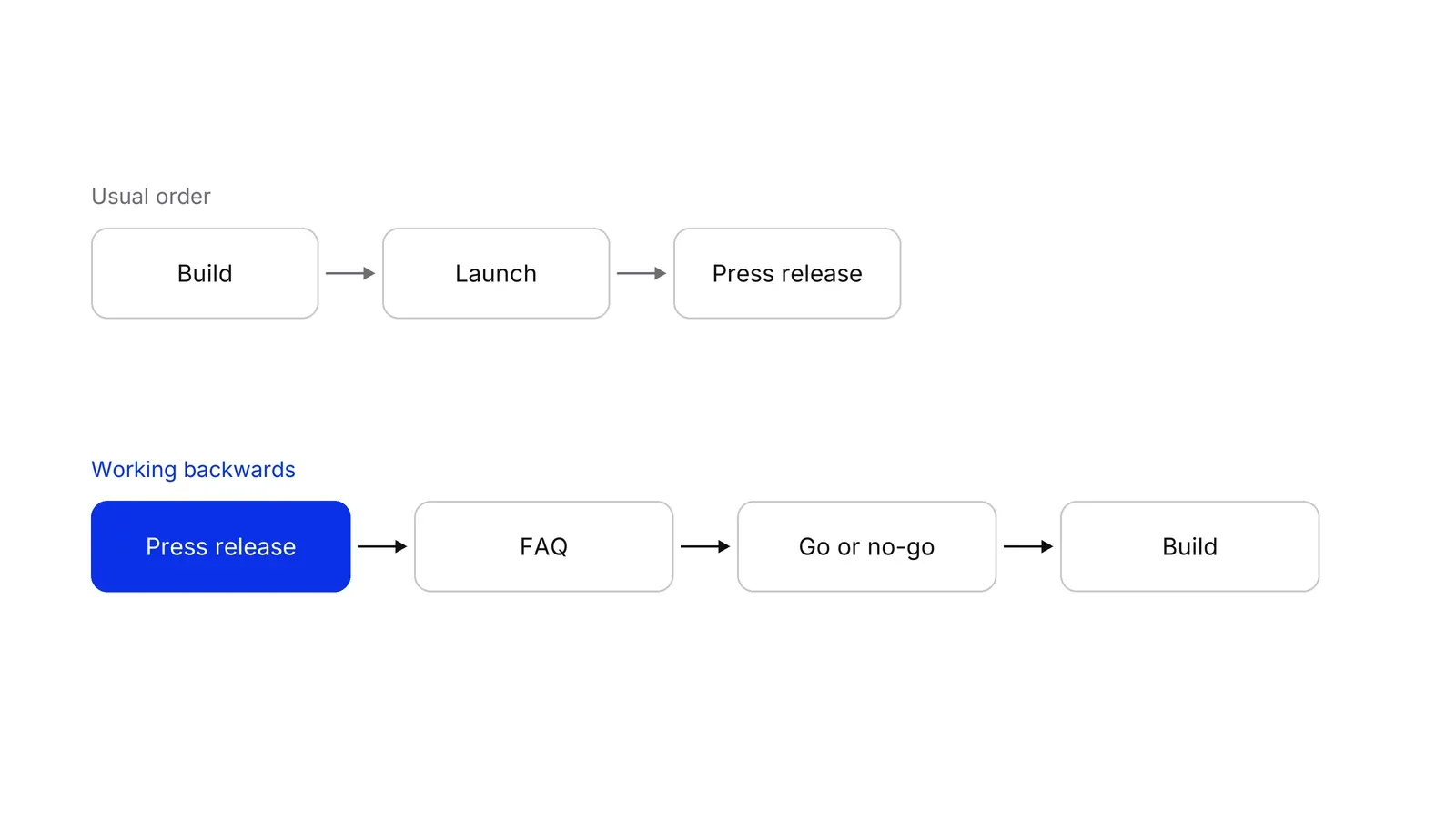
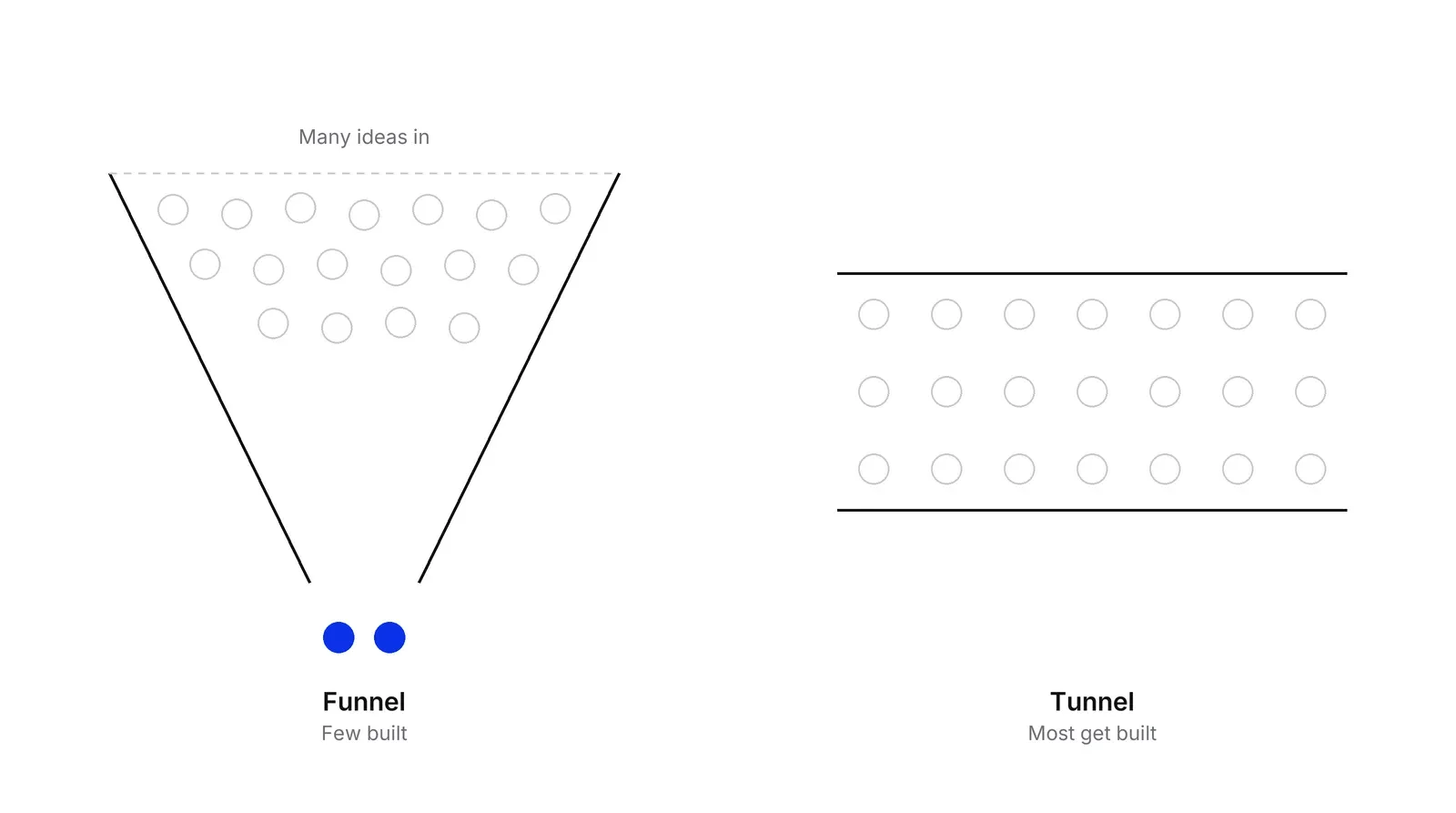
The order is reversed from the usual one. Most teams build, launch and then write the announcement. Here the announcement comes first, and it is cheap to rewrite. Bryar and Carr’s site says the method should work as a funnel, not a tunnel: many ideas go in, few come out.
What goes in the PR/FAQ?
The press release has a heading and subheading that name the product and the customer, a dated summary paragraph, a problem paragraph, a solution paragraph that states how the product differs from what customers use today, two quotes (one from your company, one from a hypothetical customer) and a line on how to start. The authors say it is always less than one page, and their template tells authors to pick the problem with the largest market, meaning the number of customers with the problem times what they would pay to fix it.
The FAQ comes in two halves. External questions are the ones customers and journalists ask: price, how it works, where to get help. Internal questions are the ones leaders ask: what customers use today, per-unit economics, upfront investment, dependencies, regulatory issues, the assumptions that must hold and the top three reasons the product could fail. The authors say the FAQ should be five pages or less.
How does the review meeting work?
Reviewers read the document in silence for 15 to 20 minutes, then spend about 40 minutes on questions and debate, according to the authors’ site. The goal is truth-seeking, not selling. The same site lists seven tests reviewers apply, among them whether the customer and problem are clearly defined, whether customers would change their behavior and whether the product is better, cheaper or faster than substitutes.
The silent reading comes from a wider Amazon habit. Jeff Bezos wrote in the 2017 shareholder letter that Amazon does not use slide presentations and uses narratively structured six-page memos instead, which the room reads at the start of a meeting. The authors say the practice was inspired by Edward Tufte’s critique of PowerPoint, whose essay argues that slideware often reduces analytical quality. Their limit is six pages for a one-hour meeting and three for a 30-minute one.
What happens after the first draft?
The first draft is rarely the last. The authors write that fidelity and detail increase with each draft: a single author, then a manager and peers, then a cross-functional group of about ten, then executives. The ending is a go or no-go. A go comes with resources and rough timing already in the FAQ. A no-go can come from a copycat idea, a small market, high risk or upfront cost, technical infeasibility or a crowded backlog. They add that the most successful Amazon products took months of this, and that the AWS team spent more than a year on its PR/FAQs.
Kindle is the product the authors name first. They say the first new product they built this way was the Amazon Kindle. It launched in November 2007 at $399 with more than 90,000 books, and Bezos said Amazon had spent three years developing it. Nothing public shows what the Kindle’s own PR/FAQ said, so treat this as the authors’ account.
Where does the method fall short?
A PR/FAQ is a document of assumptions, not evidence. Amazon’s own record shows it. The Fire Phone launched in July 2014 at $199 with a contract and led to a $170 million charge, and Bezos later said he had made billions of dollars of failures. We found no public account of whether the Fire Phone went through a PR/FAQ, so we draw no conclusion about the method from it. The point is narrower: writing the document does not make the guesses in it true.
Two cautions follow. First, the internal FAQ asks for payback and market-size numbers, and forecasters tend to be optimistic. In a classic study, Buehler, Griffin and Ross found people underestimated their own task times, and the bias disappeared when they were told to link predictions to past experience. Base your numbers on comparable launches you have seen. Second, Bezos warned in his 2016 letter that surveys can become proxies for customers, and that good inventors study many anecdotes rather than only averages. A reviewer of the book also notes that not every principle fits a company of a different size from Amazon.
How does it compare with similar tools?
| Tool | What it does | Where Working Backwards differs |
|---|---|---|
| Positioning statement | States who the product is for and why it is different, in a sentence or two | The PR/FAQ adds the economics, risks and a go or no-go decision |
| Jobs to be done | Studies why customers switch to a product | It supplies the customer insight; the PR/FAQ turns it into a proposal. See also the HBR article |
| Pre-mortem | Assumes failure and lists causes (Klein, HBR) | The internal FAQ asks for the top three failure reasons, a short pre-mortem |
| Lean Startup MVP | Tests the idea with a real, small product (Ries) | The PR/FAQ tests the idea in writing first and costs days, not weeks |
| Product-market fit | Measures whether a live product keeps customers | It happens before the build, so it can only predict fit |
The two approaches work together. A PR/FAQ decides whether an MVP is worth building, and the MVP then tests the claims the document made. Once the product ships, the weekly business review tracks the input metrics that the launch was meant to move, a step the authors place after the PR/FAQ in Amazon’s planning chain. A Growth Lab plan starts from the same question: who is the customer, and what changes for them.
How to apply Working Backwards (PR/FAQ), step by step
- Name the customer and the problem. Write one sentence that names a specific customer and the problem they have today, and say what they use now to cope. A product meant for everyone is usually meant for no one. Result: a heading and subheading a target customer would understand without explanation.
- Write the press release as if launch day is today. Write a release of under one page: a dated summary, the problem, how the product solves it and how it differs from current alternatives, one quote from your company and one from a customer, and how to get started. Result: a draft a customer could read and react to.
- Apply the so-what test. Ask whether the release describes something meaningfully faster, easier or cheaper than the alternatives. If a reader shrugs, rewrite or drop the idea now. Result: a keep, rewrite or drop decision before anyone writes a line of FAQ.
- Write the FAQ. Answer the questions customers and journalists would ask (price, how it works, where to get help), then the ones leaders would ask (market size, economics per unit, investment, dependencies, and the top three reasons it could fail). Result: a document of five pages or less that holds the numbers and the risks.
- Review it in writing. Hand the document to reviewers, give them 15 to 20 minutes of silent reading, then spend the rest of the hour on questions. The author listens and takes notes. Result: a list of changes, and a clear sense of whether the idea survives.
- Iterate, then decide. Redraft with each round of feedback, widening the audience from peers to a cross-functional group to executives. End with go or no-go. Result: a go that already names resources and rough timing, or a no-go with a stated reason.
Examples
Amazon's own template: Phoenix 400 versus Excel 850
The Working Backwards authors teach the method with two invented cars. The Phoenix 400 is a petrol SUV with no meaningful edge over existing options, and the authors say to discard that release before writing an FAQ. The Excel 850 is a zero-emission car with an 850-mile range, a 15-minute recharge and a price well below the Phoenix. It starts from what customers want, and it forces hard engineering questions, which is the intended result.
A payments company and an invoice-to-payout feature
Illustrative, no real company implied. A cross-border payments team wants to add automatic payouts to freelancers. The first release draft says 'Faster payouts'. Reviewers ask who exactly waits today and for how long. The second draft names freelancers who invoice agencies in another currency and wait days for funds. The FAQ then has to state fees, compliance checks per country and what happens when a payout fails. Two of those answers show the feature needs a licence the company does not hold, so the team narrows the first launch to one corridor.
A physiotherapy clinic and online booking
Illustrative, no real clinic implied. A clinic owner drafts a release for a booking page for patients recovering from knee surgery. Writing the quote from a hypothetical patient shows the real pain is not booking but knowing which exercises to do between visits. The release is rewritten around a short plan sent after each session, and the booking page becomes a minor feature.
When to use it
Use it before committing a team and a budget to a new product, a major feature or a new market, when the idea is still cheap to change. It suits founders who find their roadmap is a list of things they can build rather than things a customer asked for, and leadership teams that need one document to argue over.
When not to use it
Skip it for small, reversible changes where shipping and watching the data is faster than writing. It also cannot replace talking to customers: the document holds your assumptions, and a PR/FAQ written without customer contact can look rigorous while resting on guesses.
Common mistakes
- Starting from what the team can build and writing the release to justify it, instead of starting from a customer problem.
- Writing marketing copy full of adjectives. The release should be plain enough that a customer could say whether they would switch.
- Treating the FAQ as a formality and leaving the internal questions on economics, dependencies and failure reasons vague or optimistic.
- Presenting the document to reviewers instead of letting them read and challenge it, which turns a truth-seeking review into a sales pitch.
- Keeping the PR/FAQ as a one-time approval document that nobody reopens when the build changes the facts.
FAQ
What is Working Backwards at Amazon?
It is Amazon's way of developing products by writing the customer-facing story first. Teams draft a press release and FAQ describing the finished product, test the idea against it, and only then build. Colin Bryar and Bill Carr, former Amazon executives, say most of Amazon's major products since 2004 were created this way.
How long is a PR/FAQ?
Bryar and Carr describe the press release as always under one page and the FAQ as five pages or less. The 'six-page memo' people hear about is a related Amazon document: a narrative of up to six pages for a one-hour meeting, or three pages for a 30-minute one.
Who invented the PR/FAQ?
Sources do not name one inventor. The authors say Jeff Bezos's insight and trial and error shaped it after 2004. Werner Vogels, Amazon's chief technology officer, described writing the press release first in a November 2006 blog post. We found no earlier public account.
Is Working Backwards the same as backward planning?
No. Backward planning starts from a deadline and schedules tasks toward it. Working Backwards starts from the customer's view of the finished product and asks whether it is worth building at all. It sets direction and the go or no-go decision, while a schedule comes later.
Sources
- Working Backwards (Bryar and Carr), Working Backwards PR/FAQ process
- Working Backwards (Bryar and Carr), PR/FAQ instructions and template
- Working Backwards (Bryar and Carr), Narratives and decision making
- Working Backwards (Bryar and Carr), Quarterly and monthly business reviews
- Working Backwards (Bryar and Carr), Single-threaded leadership
- Working Backwards (Bryar and Carr), Correction of Errors template
- Amazon, An insider look at Amazon's culture and processes (excerpt from Working Backwards)
- Amazon, 2017 letter to shareholders
- Amazon, 2016 letter to shareholders
- Amazon, Leadership principles
- Werner Vogels, Working Backwards, All Things Distributed, 1 November 2006
- Gary Klein, Performing a Project Premortem, Harvard Business Review, September 2007
- Clayton Christensen, Taddy Hall, Karen Dillon, David Duncan, Know Your Customers' Jobs to Be Done, Harvard Business Review, September 2016
- Steve Blank, Why the Lean Start-Up Changes Everything, Harvard Business Review, May 2013
- Eric Ries, The Lean Startup, Principles
- Roger Buehler, Dale Griffin, Michael Ross, Exploring the Planning Fallacy, Journal of Personality and Social Psychology 67(3), 1994
- Edward Tufte, The Cognitive Style of PowerPoint: Pitching Out Corrupts Within
- Macworld (IDG News Service), Amazon announces Kindle, November 2007
- Fortune, Jeff Bezos on the Fire Phone and failure, 2 December 2014
- Harvard Business School, Digital Innovation and Transformation, The Fire Phone write-down case
- Yevgeniy Brikman, Review of Working Backwards by Colin Bryar and Bill Carr, 2023
Last updated Oct 9, 2026


Marketing agency or growth system: when a company outgrows its agency
An agency is the right call while the founder still runs most of the company. Once the business starts copying itself into new locations or markets, it needs a system that sets goals, tests hypotheses and owns the result.

Why healthcare marketing agencies stall: the short, mid and long wins model we use with clinics
Most agencies own the click and nobody owns the front desk. How we structure clinic work in three horizons, the research behind each one, and one year of results.

Why channel tests stall after month three
Most paid channel tests do not end with a decision. They end when the budget runs out, the attribution model changes, or everyone quietly stops looking at the dashboard.