The Mom Test
The Mom Test is a set of rules from Rob Fitzpatrick's 2013 book for running customer conversations that produce facts instead of polite lies, and for telling a real buyer from a friendly listener.
The Mom Test is a method for customer interviews from Rob Fitzpatrick's 2013 book of the same name. It says to ask about the customer's life and specific past events, not about your idea or their future plans, and to talk less than they do. A meeting counts as a success only if the customer commits time, reputation or money to a next step.
- Origin
- Rob Fitzpatrick, 2013
- Level
- 201 · Tool
- Fits
- Startup
- Time to apply
- an hour to rewrite your question list, then 30 to 45 minutes per conversation
- What you need
- a written list of the three things you most need to learn this week · five to ten people who have the problem you think exists · a notes template that separates facts, opinions and commitments
The Mom Test is a method for customer interviews that gets you facts even from people who want to be nice to you. It comes from Rob Fitzpatrick’s short book of the same name, self-published through CreateSpace on 10 September 2013 and, according to Unusual Ventures, revised in 2014. Fitzpatrick went through Y Combinator in 2007, and the book’s site says it is taught at Harvard, UCL, Seedcamp and Shopify.
The name explains the idea. Your mother will praise your business idea because she loves you. A good question gets a useful answer even from her, because it asks about what she did, not what she thinks of your plan.
Founders use it in the first weeks of a new product, before writing code. Product managers use it before a big feature. Salespeople use the second half of the method, about commitments, to tell real deals from friendly chats.
Why do customers mislead you?
Most customers who mislead you are being kind. When people know you built something, they lean toward saying they like it. A 2012 study by Dell and colleagues ran 450 interviews in Bangalore and found respondents were about 2.5 times more likely to prefer a device they thought the interviewer had made, even when the two options were identical. They preferred it even after it was made clearly worse.
Psychologists have names for this. Martin Orne’s 1962 paper called the cues that tell people what a researcher hopes to hear “demand characteristics”. Ivar Krumpal’s 2013 review describes social desirability bias: people overstate what looks good and hide what looks bad.
Predictions are weak too. Sheeran and Webb’s 2016 review concludes that people act on their intentions roughly half the time. Jakob Nielsen gave designers the same advice in 2001: watch what people do, because what they say they will do is a poor guide.
The three rules for questions
The rules fit on one line each, in Fitzpatrick’s own summary quoted by Unusual Ventures. In plain terms:
- Ask about their life, and keep your idea out of it.
- Ask about specific things that already happened, not general habits or future plans.
- Let them do most of the talking.
The first rule removes the trigger for politeness. If you never describe your product, there is nothing to compliment. The second rule swaps guesses for memories. “Would you pay for this?” asks for a prediction; “What did you spend on this last quarter?” asks for a fact. Teresa Torres gives the same advice for product discovery: anchor the interview in one recent, specific instance.
The third rule is the hardest in practice. Founders love their idea, and silence feels awkward. Nielsen Norman Group’s guide to leading questions explains why talking more makes data worse: people echo the interviewer’s words.
| Bad question | Why it fails | Better question |
|---|---|---|
| Do you think this is a good idea? | Invites a compliment | How do you handle this today? |
| Would you buy a tool that does X? | Asks for a prediction | When did this last happen, and what did you do? |
| How much would you pay? | Hypothetical number | What do you spend on this now? |
| What features do you want? | Hands design to the customer | Why do you want that? What do you do without it? |
Three kinds of bad data
Fitzpatrick names three kinds of answers that feel like progress and are not. Compliments come first: “That sounds great” tells you the person is polite. In a SaaS Club interview he describes “let me know when it launches” as a compliment combined with a stall.
Fluff is the second kind. It comes as generic claims (“I always”, “I never”), future promises (“I would”, “I will”) and hypotheticals (“I might”). The cure is to pull the person back to the last real instance.
Ideas and feature requests are the third. They are worth hearing, but not worth building straight away. Ask what problem the request would solve and how the person copes now.
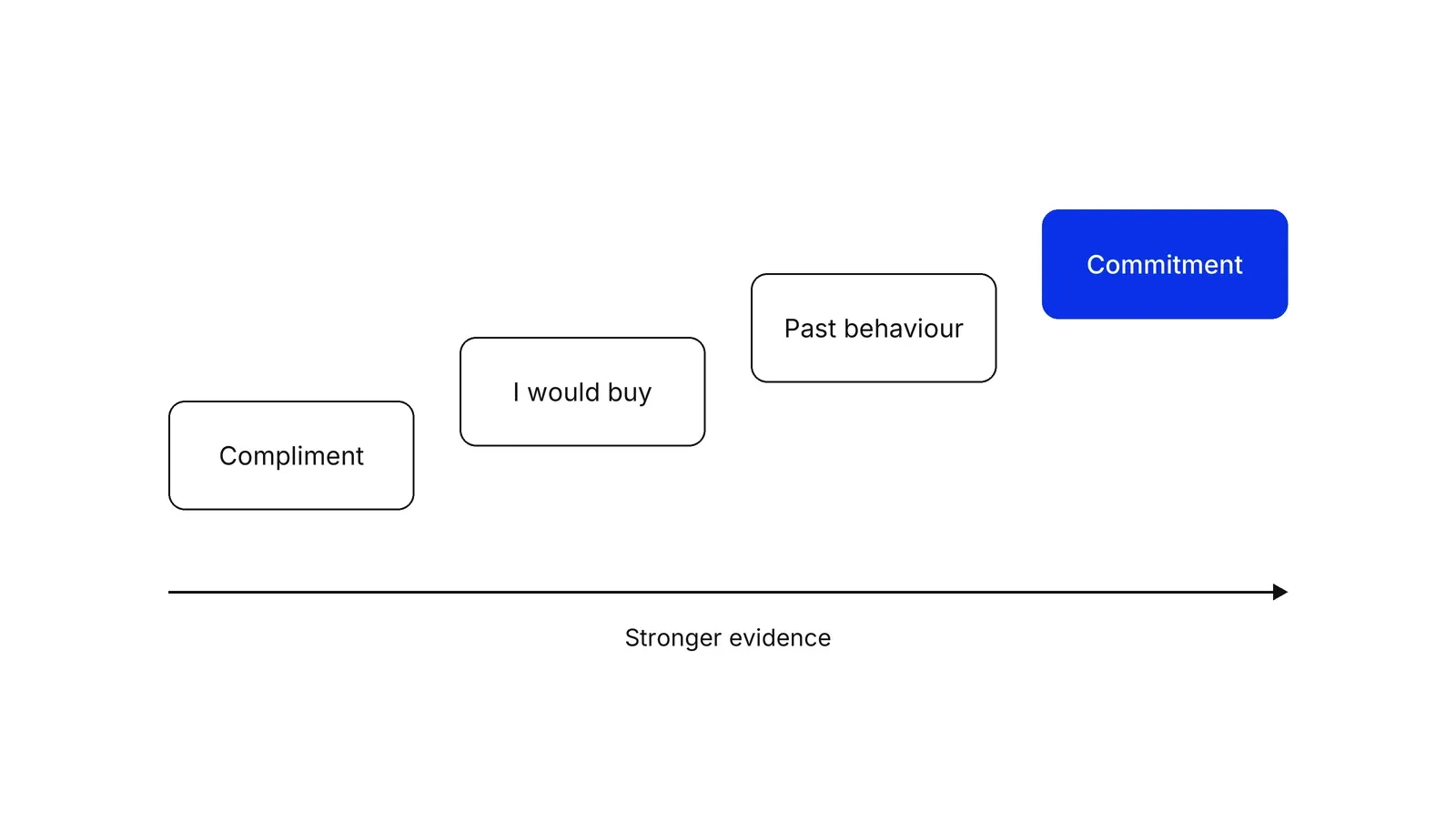
Commitment and advancement
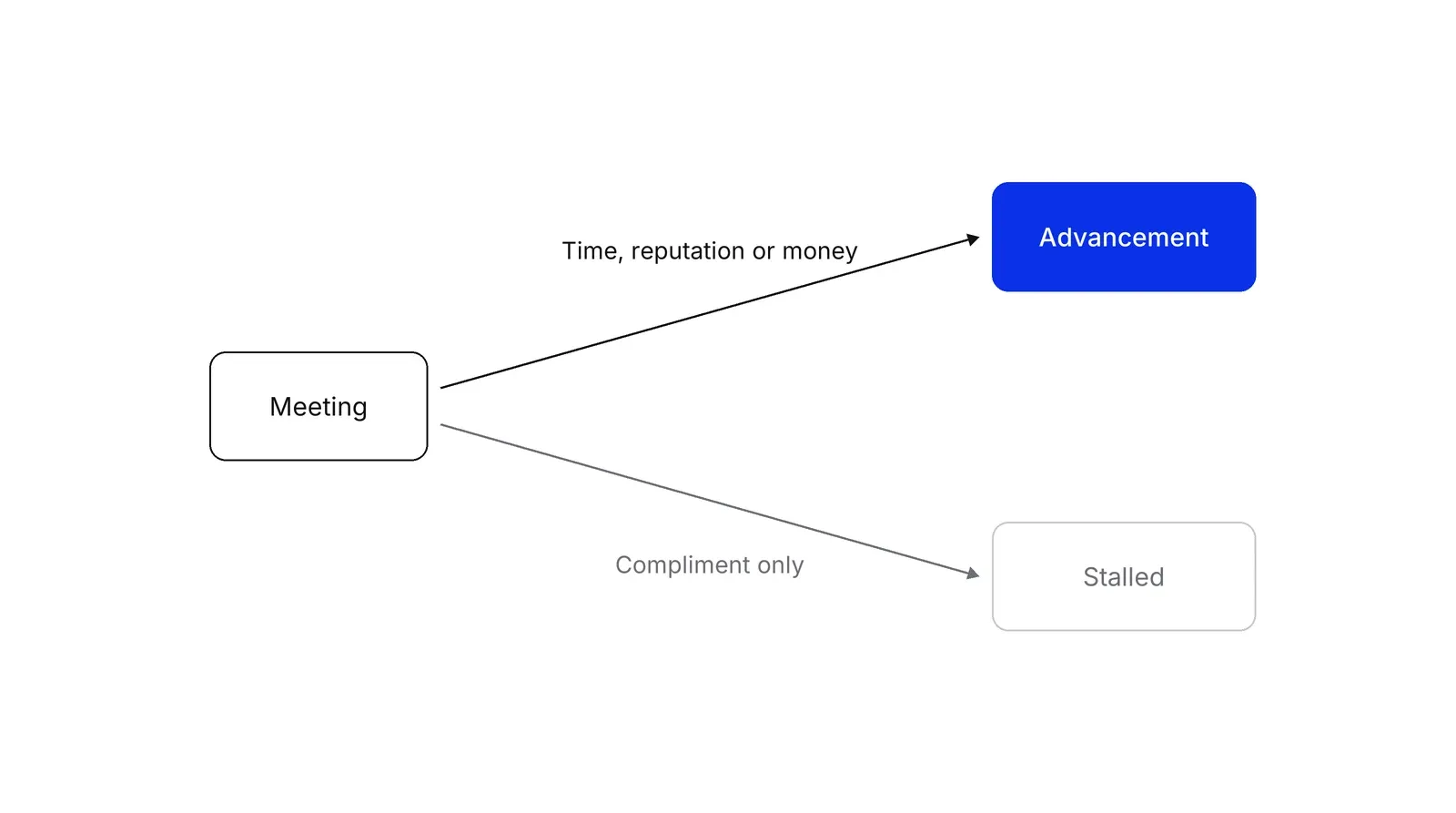
The second half of the book is about how to end a meeting. Fitzpatrick’s test, as summarised by Unusual Ventures, is that a meeting succeeds when it ends with a commitment or a clear next step. A commitment means the customer gives up something they value: time, reputation or money. Advancement means they move one step closer to buying.
Examples of time are a second meeting with a set agenda or a trial on their own data. Reputation means an introduction to their boss or a colleague. Money means a deposit, a pre-order or a paid pilot. The more someone gives up, the more you can trust what they told you.
A meeting that ends with praise and no next step is a failure, even if it felt warm. In Fitzpatrick’s words on the podcast, ask for something people will only give you if they are serious.
How it compares with other interview methods
The Mom Test sits beside a few methods it is often confused with. The table shows what each one is for.
| Method | Main question | Best moment |
|---|---|---|
| The Mom Test | Is this problem real, and will anyone commit? | Before building, early sales |
| Jobs to be done interview | What progress was the customer trying to make when they switched? | When you have recent buyers to interview |
| Usability test | Can people use this design? | When a prototype exists |
| Survey | How common is this answer across many people? | After interviews tell you what to ask |
It also feeds directly into a Lean Canvas: each interview tests the problem and customer boxes, and commitments are the first evidence for the revenue box. Y Combinator teaches a close cousin. Eric Migicovsky’s Startup School talk, as YC’s recap lists, warns against pitching, hypotheticals and talking too much, and suggests opening with “what is the hardest part” and “tell me about the last time”.
Limits and criticism
The method has real limits. A handful of interviews cannot tell you how big a market is. And the people who teach it do not always rely on it: Migicovsky writes that his talk drew on the book but that he rarely uses the framework himself, because he builds products he wants.
Michael Lynch’s review points to a tension: you are told not to pitch, then told to ask for a commitment. In practice the two belong to different meetings. Early conversations are for learning about the problem; the ask comes once you have something specific to offer.
The wider evidence supports the approach behind it. In a randomised trial described by its authors at Innovation Growth Lab, founders trained to state and test hypotheses dropped weak ideas sooner and earned more revenue on average than a control group. That trial tested hypothesis-driven work in general, not the Mom Test by name. In Pushers’ Growth Lab work, customer conversations of this kind come before any channel or budget decision.
How to apply The Mom Test, step by step
- Write down what you need to learn. Before you book anyone, list the two or three beliefs that would kill the idea if they were wrong, such as 'clinic managers lose money on no-shows' or 'finance teams reconcile payments by hand'. Result: a short list of beliefs each conversation must test.
- Turn every belief into a question about the past. Replace 'Would you use an app that reminds patients?' with 'Tell me about the last week a patient missed an appointment. What did you do?' Ask what they have already tried and what it cost them. Result: a question list with no hypotheticals and no mention of your product.
- Keep the conversation casual and short. Frame it as wanting to learn how they handle the problem today, not as a demo. Let them talk for most of the time, and follow up on anything they get emotional about. Result: a conversation where the other person does most of the talking.
- Deflect compliments and dig under requests. When someone says your idea sounds great, thank them and steer back to what happened last time. When they ask for a feature, ask why they want it and what they do without it now. Result: notes that record behaviour and motives, not praise.
- Ask for a commitment before you leave. Once you have something to show, end with a concrete ask: a second meeting with their manager, a trial on real data, a pre-order or a deposit. Result: either a next step with a date, or a clear sign the lead is not real.
- Review notes with the team the same day. Sort what you heard into facts, opinions and commitments, and update the beliefs list. Drop or change any belief that two or three conversations contradicted. Result: a revised list of what to learn next week.
Examples
A no-show reminder tool for dental clinics
Illustrative. A founder asks clinic managers whether they would pay for automated reminders, and eight of ten say yes. Rewritten with the Mom Test, the question becomes: how many patients missed appointments last month, and what did the clinic do about it? Six managers cannot give a number and say the front desk already phones patients the day before. Two track no-shows weekly and lose about ten slots a month. Those two agree to a paid trial on their own booking data. The founder now has two real leads instead of eight polite ones.
Reconciliation software for small online shops
Illustrative. A fintech team believes shop owners hate matching card payouts to orders. Interviews ask: when did you last reconcile, how long did it take, and what tool did you use? Most owners say their accountant does it once a quarter and they never see the work. The pain belongs to accountants, so the team reruns interviews with bookkeepers who serve 20 or more shops, and one bookkeeper introduces them to her firm's partner.
An internal analytics tool
Illustrative. A product manager at a hospital group proposes a dashboard for ward managers. Instead of asking whether they want it, she asks each manager to show the last report they built and how long it took. Three managers open spreadsheets they update by hand every Monday. One offers to give up an hour each week for a pilot, which is a time commitment she can take to her budget holder.
When to use it
Use it whenever you talk to potential customers about a problem you might solve: before building a product, before adding a major feature, when testing a new segment or price, and in early sales calls. It suits founders and product teams who have no data yet and need to know whether a problem is real and who feels it most.
When not to use it
It is the wrong tool for measuring how common a problem is across a market, which needs a survey or usage data, and for testing whether people can use a finished interface, which needs a usability test. It also adds little when you already have sales and usage data that answers the question. Do not use it to collect feature votes.
Common mistakes
- Pitching the idea in the first five minutes. Once people know what you are building, they start being polite about it.
- Counting 'I would definitely buy that' as validation. A promise about the future costs nothing to give.
- Writing down feature requests as a roadmap instead of asking what problem each request is meant to solve.
- Leaving with a compliment and 'let me know when it launches', and logging it as a warm lead.
- Asking only friends and family, who have the strongest reason to protect your feelings.
FAQ
What is the Mom Test?
It is a customer interview method from Rob Fitzpatrick's 2013 book. The idea is to ask questions even your mother could not lie to you about: questions about what people did, what it cost them and what they tried, not about whether your idea is good. Good answers are facts about the past, and the strongest signal is a commitment.
What are the three rules of the Mom Test?
First, talk about the customer's life rather than your idea. Second, ask about specific things that already happened rather than general opinions or future plans. Third, talk less and listen more. Together they keep the other person describing real behaviour instead of reacting to your pitch.
Why is it called the Mom Test?
Your mother loves you and wants you to be happy, so she will praise your business idea whatever she thinks of it. Fitzpatrick's point is that a good question gets a useful answer even from someone that biased. If a question only works with a neutral stranger, it is a bad question.
What are examples of good Mom Test questions?
Good questions ask about the past and the specific: When did this last happen? What did you do about it? What else have you tried? How much does it cost you now? Who else is involved in the decision? Bad questions ask for predictions or opinions: Would you buy this? Do you think this is a good idea?
Is the Mom Test enough to validate a startup idea?
No. It tells you whether a problem is real and who feels it, from a small number of conversations. It cannot measure market size, and even Eric Migicovsky, who taught it at Y Combinator, says he rarely uses it for his own products. Treat interviews as one test among several, and back them with commitments and real usage.
Sources
- Rob Fitzpatrick, The Mom Test, official book site
- Fox and Fable, The Mom Test listing (CreateSpace, 10 September 2013)
- Unusual Ventures, Rob Fitzpatrick's Mom Test, 2024
- SaaS Club podcast, episode 206 with Rob Fitzpatrick
- Startup Istanbul podcast, The Mom Test with Rob Fitzpatrick, 2024
- Eric Migicovsky, Startup School: How to talk to users, 2019
- Y Combinator, Startup School week 1 recap: Kevin Hale and Eric Migicovsky
- Dell, Vaidyanathan, Medhi Thies, Cutrell and Thies, "Yours is better!" Participant response bias in HCI, CHI 2012
- Martin Orne, On the social psychology of the psychological experiment, American Psychologist, 1962
- Ivar Krumpal, Determinants of social desirability bias in sensitive surveys, Quality & Quantity, 2013
- Paschal Sheeran and Thomas Webb, The intention-behavior gap, Social and Personality Psychology Compass, 2016
- Jakob Nielsen, Nielsen Norman Group, First rule of usability? Don't listen to users, 2001
- Amy Schade, Nielsen Norman Group, Avoid leading questions to get better insights from participants, 2017
- Teresa Torres, Product Talk, Story-based customer interviews
- Innovation Growth Lab, Camuffo, Gambardella, Cordova and Spina on the scientific approach to entrepreneurial decisions, 2020
- Michael Lynch, book report: The Mom Test
- Yevgeniy Brikman, 'The Mom Test' by Rob Fitzpatrick, 2023
- University of British Columbia, Entrepreneurship course, customer interview video
- Giff Constable and Frank Rimalovski, Talking to Humans
- Eric Ries, The Lean Startup, principles
- Steve Blank, Harvard Business Review, Why the lean start-up changes everything, 2013
- Christensen, Hall, Dillon and Duncan, Harvard Business Review, Know your customers' jobs to be done, 2016
Last updated Oct 9, 2026


Marketing agency or growth system: when a company outgrows its agency
An agency is the right call while the founder still runs most of the company. Once the business starts copying itself into new locations or markets, it needs a system that sets goals, tests hypotheses and owns the result.

Why healthcare marketing agencies stall: the short, mid and long wins model we use with clinics
Most agencies own the click and nobody owns the front desk. How we structure clinic work in three horizons, the research behind each one, and one year of results.

Why channel tests stall after month three
Most paid channel tests do not end with a decision. They end when the budget runs out, the attribution model changes, or everyone quietly stops looking at the dashboard.