Programmatic SEO
Programmatic SEO builds many landing pages from one template and a dataset, each aimed at a narrow long-tail search, and works only while every page adds something Google's scaled content abuse policy can see.
Programmatic SEO is the practice of generating many search landing pages from one template and a structured dataset, each targeting a narrow long-tail query. It works when every page carries data or function that other pages lack. Since March 2024, Google's scaled content abuse policy treats mass-produced pages made mainly to manipulate rankings as spam, however they were made.
- Origin
- No single originator; the practice is associated with data-rich sites such as Zapier and Tripadvisor, Policy line drawn by Google on 5 March 2024
- Level
- 201 · Tool
- Fits
- Startup, Scale-up
- Time to apply
- Two weeks to test a pattern with 20 to 50 pages before scaling
- What you need
- a dataset you own or license, with fields that differ per page · a search pattern with proven demand, such as [thing] + [modifier] · Search Console access to watch indexing
Programmatic SEO is the practice of generating many landing pages from one template and a structured dataset, so that each page answers a narrow search. The searches sit in the long tail: queries that are small one by one and large in total, such as “Slack Google Sheets integration” or “GBP to USD”. No single author owns the term. The practice grew up on sites with a lot of structured data, and Tripadvisor’s annual report shows how much such a company depends on search engines, naming Google, to bring in visitors.
How does a programmatic page set work?
A programmatic page set is a template multiplied by data. You pick a query pattern, such as “[app] + [app]” or “[currency] to [currency]”, build one page layout, and let the dataset fill in everything that differs between pages.
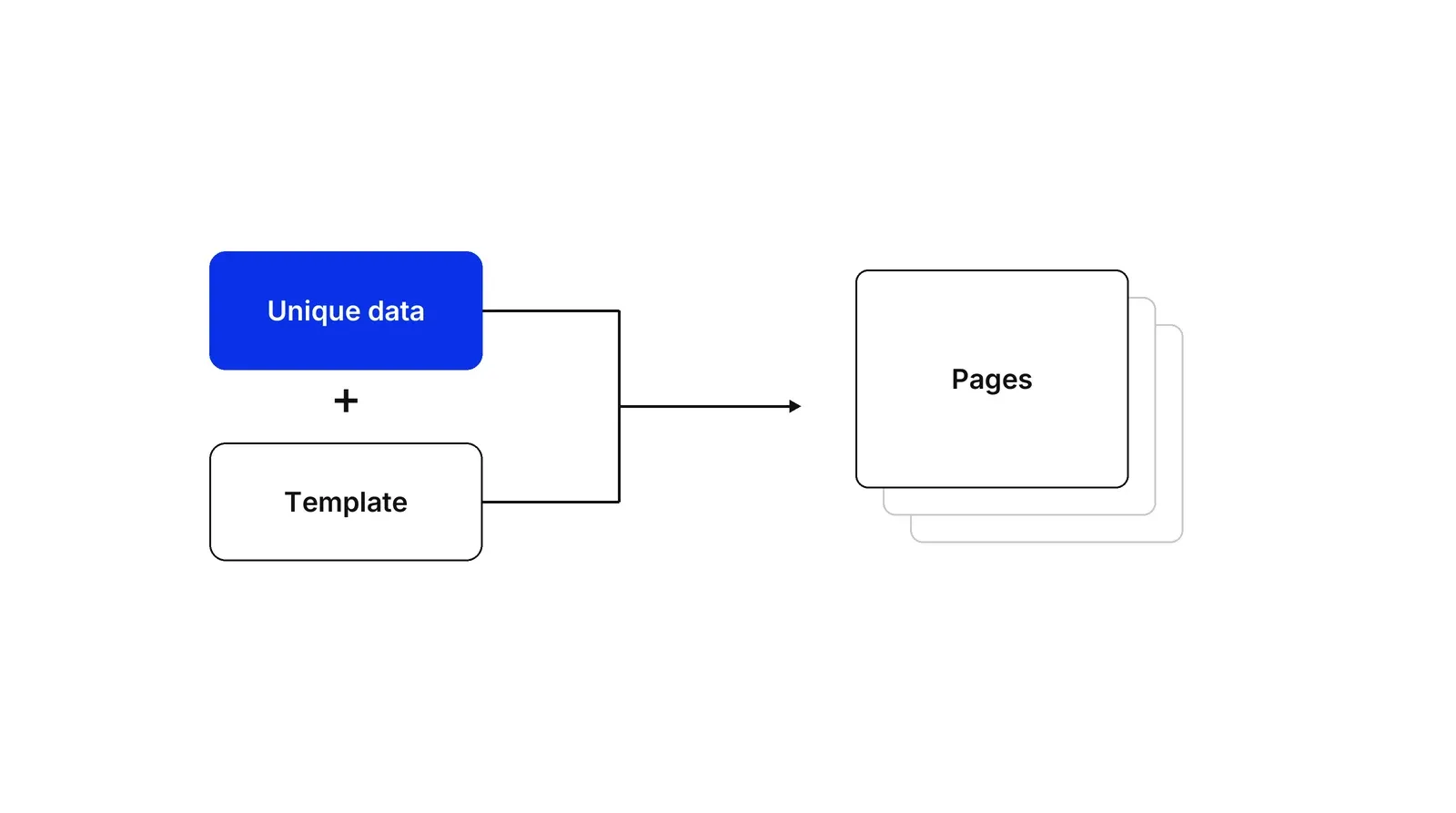
The value sits in the data, not in the template. Zapier’s app directory lists more than 10,000 apps, and its Slack and Google Sheets page lists the triggers and actions of each app inside Zapier. Zapier owns that data because it is the product. Wise’s GBP to USD page shows a live rate, a rate chart, 30- and 90-day highs and lows and conversion tables. Menus, footers and legal text repeat on every page, while the numbers change.
What does Google’s scaled content abuse policy say?
Google’s [spam policies] define scaled content abuse as the case where “many pages are generated for the primary purpose of manipulating search rankings”(https://developers.google.com/search/docs/essentials/spam-policies). It announced the policy on 5 March 2024, alongside the March 2024 core update and two other new policies, expired domain abuse and site reputation abuse, in a Search Central post. The policy builds on the older rule against automatically generated content and covers automation, human effort or a mix of both.
The listed examples are generating many pages with AI tools without adding value, scraping feeds or search results (including by synonymizing or translating), stitching content from other pages, running several sites to hide the scale, and pages that make little sense but contain keywords. Google says it finds violations through automated systems and human review, and affected sites may rank lower or not appear at all.
Google said it expected the March changes to cut low-quality, unoriginal content in results by 40%. Its announcement page later reported that the rollout finished on 19 April, with 45% less of that content.
Automation itself is allowed. In a 2023 post Google noted that automation has long produced helpful content such as sports scores, weather forecasts and transcripts. Google also named its SpamBrain system as part of the spam-fighting effort. The line is purpose and value, not method.
Human quality raters apply the same idea. Section 4.6.5 of the Rater Guidelines tells raters to give the Lowest rating to pages made at scale with no original content or added value, and gives a question-and-answer site built from “People also ask” questions as an example. Raters do not change rankings directly; the ratings help Google test its systems.
Three spam policies get mixed up with each other:
| Policy | What it targets |
|---|---|
| Scaled content abuse | Many pages made mainly to rank, with little value, however made |
| Doorway abuse | Pages made to rank for similar queries that lead users to an intermediate page, such as one page per city funnelling to one destination |
| Thin affiliation | Affiliate pages with descriptions and reviews copied from the merchant |
What separates a good page set from a bad one?
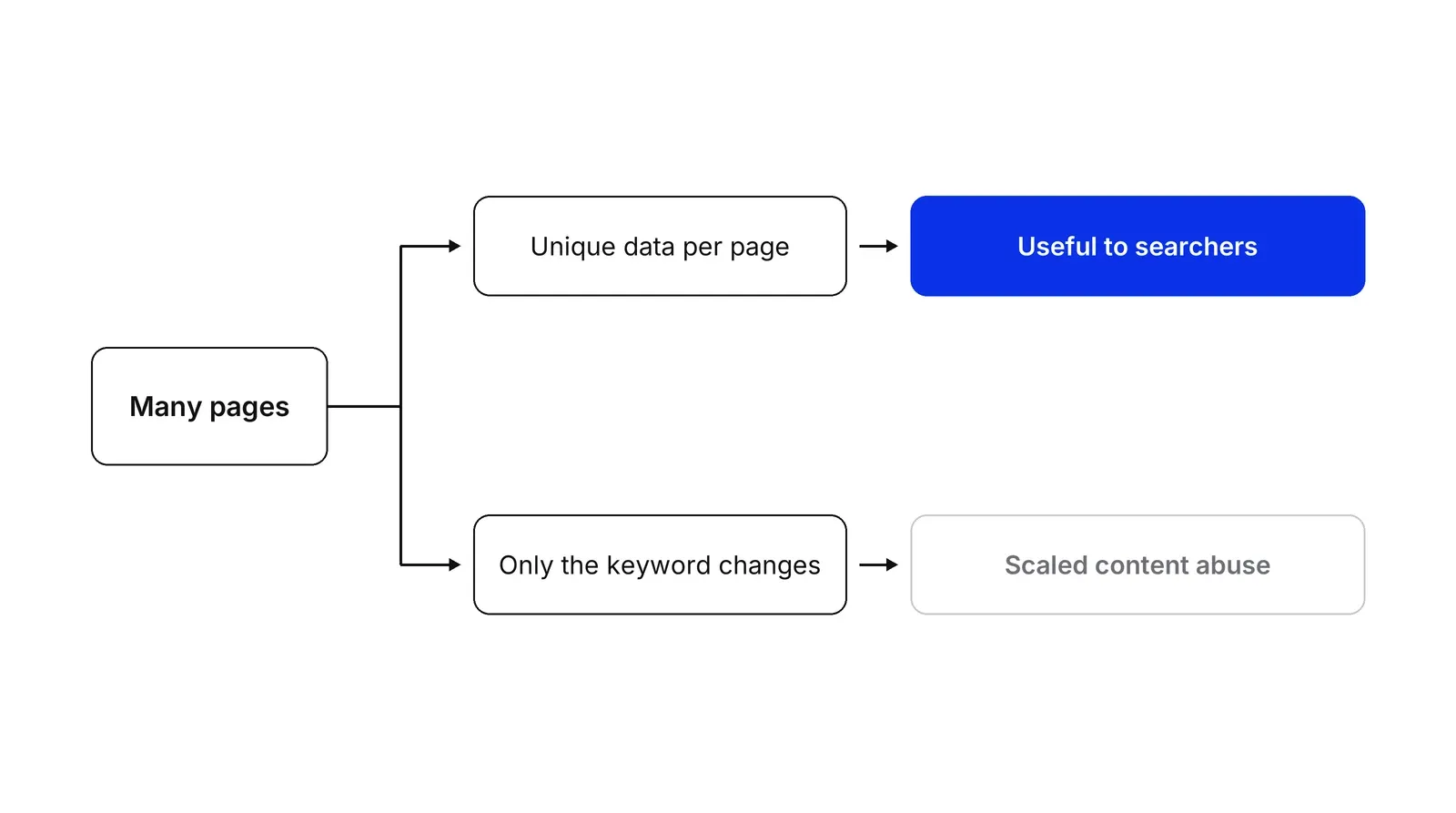
A good set gives each page data, a calculation or a tool the others lack. Google’s own helpful content questions ask whether a page provides substantial value compared with other pages in results, and whether you use extensive automation to produce content on many topics.
Spam researchers saw the pattern long before 2024. In a 2004 study, Fetterly, Manasse and Najork noted that spam sites often serve many pages that differ only by keywords inserted into a template, and found that 15 of the 20 largest clusters of near-duplicate pages were spam, covering 2,080,112 pages or 1.38% of their data set. A 2006 paper by Ntoulas and colleagues showed content analysis could catch 2,037 of 2,364 spam pages (86.2%) in a judged collection of 17,168 pages, at a 3.1% error rate. A simple test of your own: remove the keyword from a page and ask whether anything is left that only this page says.
What breaks technically at scale?
Templates multiply technical mistakes as fast as pages. Google reports “Crawled - currently not indexed” when it fetched a URL and chose not to index it, and “Discovered - currently not indexed” when it knows the URL but postponed the crawl to avoid overloading the site. A sitemap file holds at most 50,000 URLs or 50 MB. Google’s crawl budget guide is written for sites of about 10,000 pages with daily changes or about a million pages, and warns that soft 404s waste crawling.
Empty variants should return a 404, not a normal page. Each page needs its own title, and near-identical pages need a canonical. Both statuses appear in the Page indexing report in Search Console. | Check | Google figure or rule | Source | |—|—|—| | Sitemap size | 50,000 URLs or 50 MB uncompressed per file | Search Central, sitemaps | | Crawl budget guide applies to | About 1 million pages changing weekly, or 10,000 pages changing daily | Search Central, crawl budget | | Empty variants | Return 404; a 200 with an error-like page is reported as a soft 404 | Search Central, faceted navigation and HTTP status codes | | Titles | One distinct title per page; repeated boilerplate is weak | Search Central, title links | | Noindex | Needs crawling to be read; robots.txt blocks it | Search Central, block indexing |
Our technical SEO page covers the crawl and index basics, and E-E-A-T covers what makes a page trustworthy once it is indexed.
A Growth Lab plan starts from the dataset and the demand, then tests a small batch before any scaling; see Growth Lab.
How to apply Programmatic SEO, step by step
- Find a repeatable search pattern. Look for queries that share one shape, such as 'X integration with Y' or 'convert A to B', and check that people search each variant. Start from the demand, not from the data you happen to have. Result: a pattern with a head term, a modifier list and a rough count of pages.
- List what only each page can say. For each variant, write down the fields that differ: prices, rates, features, locations, reviews, a calculation. If you can name fewer than three, the pattern is too thin. Result: a field list that the template must show, and a rule for dropping variants with no data.
- Build the template around the user's task. Design the page for the person who typed the query: the answer first, the data next, a clear next step. Give each page its own title, headings and a short written part where a human adds judgement. Result: one template that reads as a useful page when the data changes.
- Publish 20 to 50 pages and watch indexing. Ship a small batch, submit a sitemap and watch the Page indexing report in Search Console for weeks. Pages stuck at 'Crawled - currently not indexed' tell you the set is not yet worth indexing. Result: evidence that Google indexes and shows the pattern before you multiply it.
- Scale in stages, with a kill rule. Add pages in batches, keep each sitemap under 50,000 URLs, return a 404 for combinations with no data, and set a rule for removing pages that get no impressions. Result: a page set that grows only where the data and the demand exist.
Examples
A software integration directory
Zapier's app directory lists more than 10,000 apps, and pages such as Slack plus Google Sheets list what each app can trigger and do inside Zapier. The data comes from the product itself, so every pair page differs. The pattern is 'app A + app B', and the unique fields are the real triggers and actions.
Currency pair pages for a payments company
Illustrative. A transfer service builds a page per currency pair. Each page shows the live rate, a rate history, 30- and 90-day highs and lows and a conversion table, which no other pair has. Wise's GBP to USD converter page is built this way. Pairs with no real transfer route are not published.
A clinic with one site and four locations
Illustrative. A dental group wants a page for every district it serves. It publishes pages only for the four districts where it has a clinic, each with the dentists, opening hours, and transport directions that apply there. Pages for 60 districts with no clinic would be doorway pages, which Google's spam policies target.
When to use it
Use it when you own structured data that differs per page, searchers use one query pattern with many variants, and each variant has a real answer. Marketplaces, directories, calculators, comparison and integration pages fit best.
When not to use it
Do not use it to cover topics you have nothing to say about. Skip it when the only difference between pages is the place name or keyword, when your data is copied from other sites, or when a person would need judgement and experience that a template cannot supply.
Common mistakes
- Swapping only the keyword. Pages that differ by a city or product name and nothing else are the standard example of scaled content abuse.
- Generating text with AI to fill the gaps. Google's guidance says using generative tools to produce many pages without added value may violate the policy.
- Publishing everything at once. Thousands of new URLs with no indexing test can leave most of them undiscovered or unindexed.
- Letting empty combinations return a normal page. Pages with no data become soft 404s and waste crawling.
- Ignoring titles and canonicals. Repeated titles and near-identical pages push Google to choose one version and ignore the rest.
FAQ
What is programmatic SEO?
It is generating many landing pages from a template and a dataset, each one aimed at a specific long-tail search such as a tool pairing or a currency pair. The pages share a layout, and the content that changes comes from data. Done well it serves searchers; done badly it becomes spam.
Is programmatic SEO against Google's guidelines?
Not by itself. Google's spam policy targets many pages generated for the primary purpose of manipulating rankings. A page set where each page gives users data or function they cannot get elsewhere is not covered. Google also says not all automation is spam, citing sports scores and weather forecasts.
What is scaled content abuse?
It is a Google spam policy announced on 5 March 2024. It covers many pages generated mainly to manipulate rankings, whether by AI, automation, humans or a mix. Examples include scraping feeds, stitching content from other pages, and pages that make little sense but contain keywords. Violations can rank lower or be removed.
How many pages can I publish at once?
Google gives no safe number. Technical limits are 50,000 URLs or 50 MB per sitemap file. For quality, test with a small batch, check that Google indexes it, and scale only if it does. Google's crawl budget guide is aimed at sites of 10,000 or more pages that change daily.
Can I use AI to write programmatic pages?
You can use it to help, but not to mass-produce thin pages. Google says generative AI is useful for researching a topic and structuring original content, while generating many pages without adding value may break the spam policy. Fact-check everything and consider saying how the content was made.
Sources
- Google Search Central, Spam policies for Google web search
- Google Search Central Blog, What web creators should know about our March 2024 core update and new spam policies, March 5, 2024
- Google, The Keyword, New ways we're tackling spammy, low-quality content on Search, March 2024 (with April 19 update)
- Google Search Status Dashboard, Ranking incident history (March 2024 core update)
- Google Search Central, Google Search's guidance on using generative AI content on your website
- Google Search Central Blog, Google Search's guidance about AI-generated content, February 2023
- Google Search Central, Creating helpful, reliable, people-first content
- Google, Search Quality Rater Guidelines (General Guidelines), section 4.6.5 Scaled Content Abuse, September 11, 2025
- Google Search Central, Google Search's core updates and your website
- Google Search Central, Build and submit a sitemap
- Google Search Central, Managing crawl budget for large sites
- Google Search Central, Managing crawling of faceted navigation URLs
- Google Search Console Help, Page indexing report
- Google Search Central, HTTP status codes, network and DNS errors (soft 404)
- Google Search Central, Influencing your title links in Google Search
- Google Search Central, What is URL canonicalization
- Google Search Central, Block Search indexing with noindex
- Google Search Central, SEO Starter Guide
- Google Search Central, Introduction to structured data markup in Google Search
- Ntoulas, Najork, Manasse and Fetterly, Detecting Spam Web Pages through Content Analysis, WWW 2006
- Fetterly, Manasse and Najork, Spam, Damn Spam, and Statistics, WebDB 2004
- Gyongyi and Garcia-Molina, Web Spam Taxonomy, AIRWeb 2005
- Zapier, App Directory
- Zapier, Slack + Google Sheets integration
- Wise, GBP to USD currency converter
- TripAdvisor, Inc., Form 10-K for fiscal year 2024, U.S. Securities and Exchange Commission
Last updated Oct 9, 2026


The compliance layer under fintech marketing operations
A fintech marketing agency can build campaigns. It cannot own the compliance review, the KYC drop-off or the multi-market licensing rules that decide whether a lead ever becomes a customer.

Fractional CMO: what you get, and what has to exist underneath
A fractional CMO brings strategy and judgment. Without reporting, CRM hygiene and a named owner per number, the engagement produces a slide deck instead of a system.

The operations layer behind healthcare patient acquisition
Ads and search bring the request in. What happens between the click and the booked, attended visit decides whether the spend paid off.