Positioning statement
A positioning statement is a short internal sentence that says who a product is for, what it is, what it does for them and why they should pick it over the alternative, so every team describes it the same way.
A positioning statement is a one or two sentence internal document that names a product's target customer, their need, the category it belongs to, its main benefit and how it differs from the main alternative. The best-known template comes from Geoffrey Moore's 1991 book Crossing the Chasm. Teams use it to keep sales, product and advertising saying the same thing.
- Origin
- Geoffrey A. Moore (template); Al Ries and Jack Trout (positioning), 1991 for the template; 1969 to 1981 for positioning
- Level
- 201 · Tool
- Fits
- Startup, Small and mid-size, Scale-up
- Time to apply
- a half-day workshop for a first draft, then two to four weeks of sales calls to test it
- What you need
- notes from 10 or more conversations with customers who bought, and a few who chose something else · a list of what those customers would use if your product did not exist · one person with the authority to pick a single target customer and a single category
A positioning statement is a short internal text that says who a product is for, what it is, what it does for them and why they should choose it over the main alternative. It usually runs to one or two sentences. Product marketers, founders and brand teams write it so that sales, product and advertising describe the product the same way.
The best-known template is credited to Geoffrey Moore’s Crossing the Chasm, published by HarperBusiness in 1991. The idea of positioning itself is older. It comes from the advertising executives Al Ries and Jack Trout, two decades before Moore.
Where the idea of positioning came from
Positioning is the place a product holds in a buyer’s mind relative to the alternatives. Ries and Trout made the term popular. Their firm’s reprint of the 1972 articles says the two first wrote about it in the June 1969 issue of Industrial Marketing. A 2011 review at IIM Indore credits that article to Trout alone, so the sources disagree on the byline.
The idea spread through a three-part series in Advertising Age, “The Positioning Era Cometh”, printed in April and May 1972, according to the Ries history page. The authors argued that a company has to create a position in the prospect’s mind, and that “you can’t compete head-on” against a brand with a strong position. Their best-known example was Avis, the number two car rental firm, which set itself against Hertz with “We try harder”. The book Positioning: The Battle for Your Mind followed in 1981. O’Dwyer’s reported on Trout’s death in 2017 that it had sold over 2 million copies.
Academics never fully agreed on a definition. In 1982, David Aaker and Gary Shansby noted that positioning meant segmentation to some managers, image to others and feature choice to others again. A 2021 literature review by Natasha Saqib still found no coherent definition. The positioning statement exists partly to solve that problem inside one company: it forces the team to write its answer down.
Moore’s template, slot by slot
Moore’s template is two sentences with six slots. The version taught in Stanford’s E145 entrepreneurial marketing course reads: For (target customer) who (statement of the need or opportunity), the (product name) is a (product category) that (statement of benefit). Unlike (primary competitive alternative), our product (statement of primary differentiation).
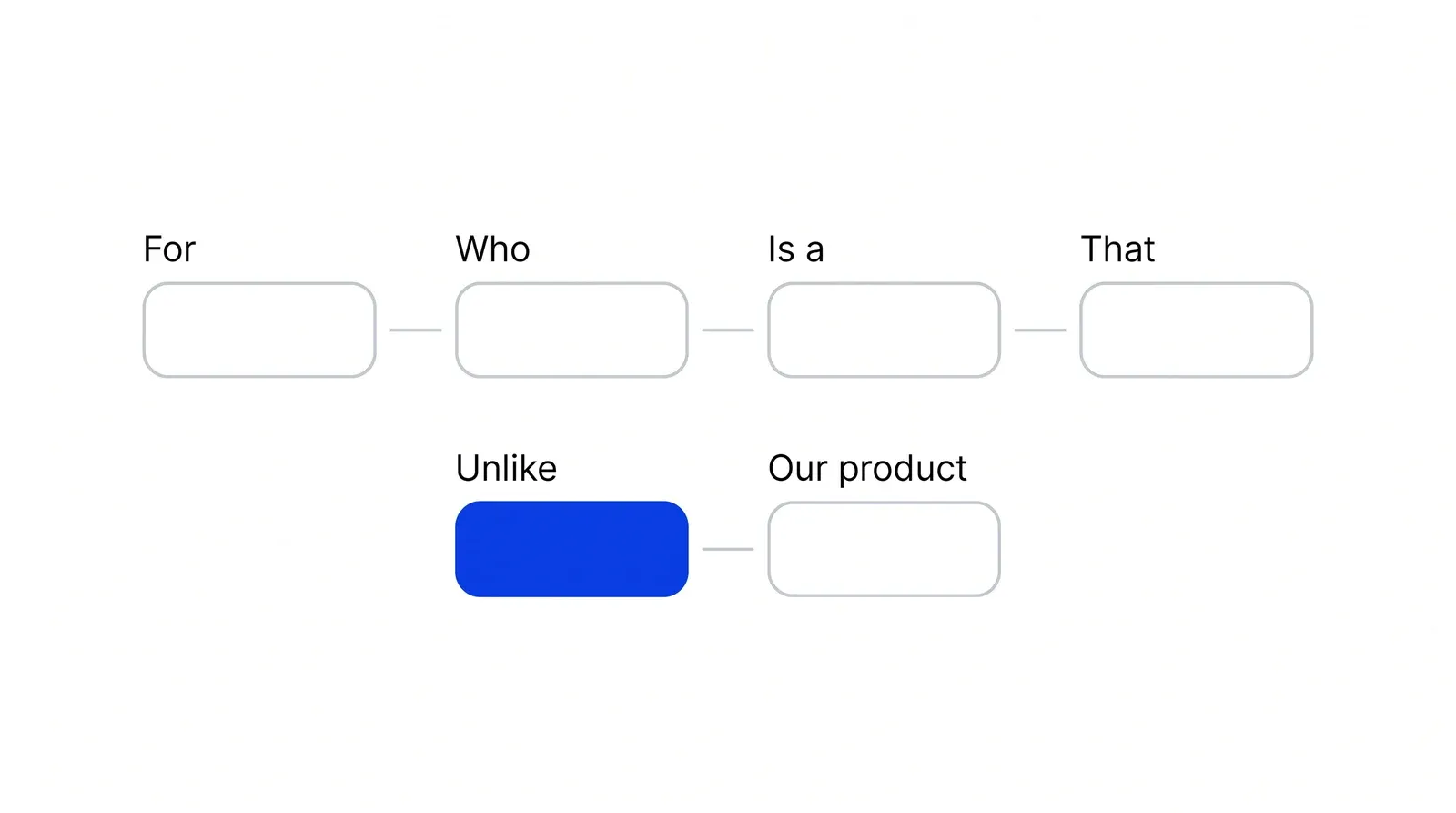
| Slot | What goes in it | Common mistake |
|---|---|---|
| For | One customer group you can name and reach | “Businesses of all sizes” |
| Who | The need or problem, in the customer’s words | A need you assume but never heard |
| Is a | The category buyers will file you under | A category nobody searches for |
| That | The main benefit | A feature instead of a benefit |
| Unlike | What buyers would use otherwise | A rival that buyers rarely consider |
| Our product | The one difference that matters to this buyer | A list of five differences |
Moore wrote the book about technology companies moving from early adopters to mainstream buyers, and the template served that goal: a claim short enough to pass what an MIT course page built on the template calls the elevator test, a pitch delivered in about 30 seconds to someone who knows nothing about the product. Wording varies between sources. TechTarget lists the same six parts, while some book summaries phrase the target as customers dissatisfied with the current alternative. The six slots stay the same.
The brand version: frame of reference and reason to believe
Consumer brand teams often use a one-sentence variant taught at Kellogg. In Kellogg on Branding, Alice Tybout lists four elements: a target, a frame of reference, a point of difference and a reason to believe. Her chapter calls the statement an internal document used to align all consumer-facing decisions about the brand.
The frame of reference is the category or goal the brand is compared within, close to Moore’s “is a” slot. The reason to believe is concrete proof that the brand delivers the benefit, which Moore’s template leaves out. In a 2002 Harvard Business Review article, Kevin Keller, Brian Sternthal and Alice Tybout added that a brand also needs points of parity: the features it must share with the category to be credible in it. A beer with no alcohol cannot claim the beer frame, however good its point of difference.
| Moore template | Kellogg brand version | Dunford components | |
|---|---|---|---|
| Form | Two sentences, six slots | One sentence, four elements | Five decisions made in order |
| Names the alternative | Yes, in “Unlike” | Through the frame of reference | Yes, as the starting point |
| Asks for proof | No | Yes, the reason to believe | Yes, value backed by proof |
| Typical user | B2B and tech product teams | Consumer brand teams | B2B product marketing |
Why April Dunford calls the template dangerous
April Dunford, author of Obviously Awesome (2019), is the best-known critic of the template. In her 2021 quickstart guide she calls it a “Mad Libs” exercise and says it is “not only pointless but potentially dangerous”. Her objection is that the blanks assume one right answer each, while a product can often fit several categories, competitors and customer groups. Filling in the blanks hides that choice.
Her alternative is to work through five components in a fixed order: competitive alternatives, differentiated capabilities, the value they deliver, the customers who care most about that value, and the market category that makes the value obvious to them. Her books page puts it plainly: positioning is not filling in the blanks on an old-school statement.
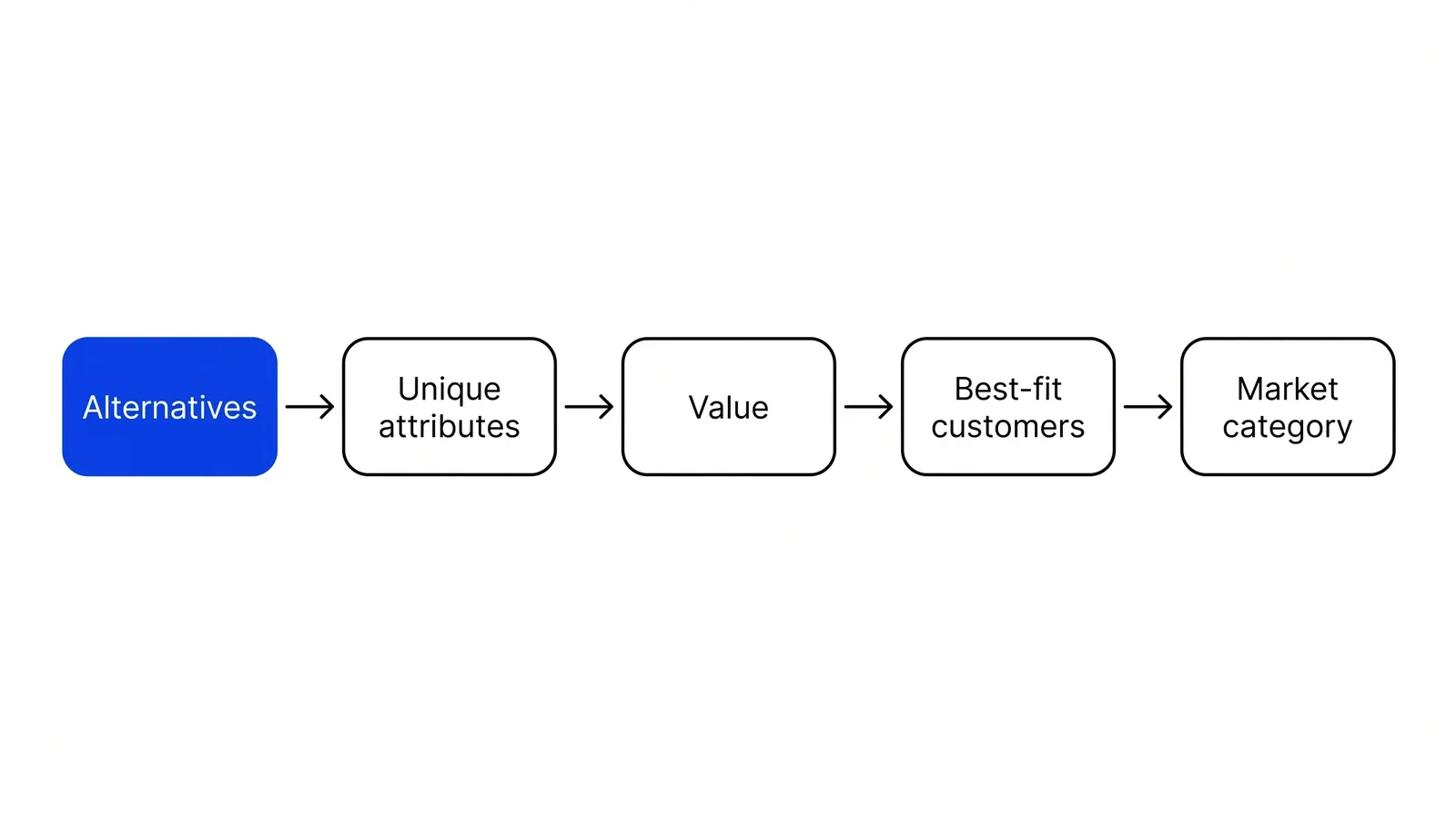
The two approaches fit together. Use Dunford’s sequence to make the decisions, then write Moore’s two sentences as the record of them. In a 2026 newsletter post, Dunford calls a pre-launch version a positioning thesis, something to test in the market before treating it as settled. That is a good way to treat any first draft.
What goes in the benefit slot
Write a benefit, not a feature. Christoph Fuchs and Adamantios Diamantopoulos tested four positioning strategies on consumers in 2010. Benefit-based positioning, and positioning by the type of user, generally beat feature-based positioning on favorability, differentiation and credibility. No single strategy won on every measure, and the authors say the results apply mainly to high-involvement purchases such as cars.
In practice that means “settles in local currency the same day” beats “built on real-time payment rails”, and “treats under sedation” beats “two staff anaesthetists”. The feature still has a place: it becomes the reason to believe.
How it fits with the value proposition and the positioning map
A value proposition describes the benefits a customer gets. A positioning statement adds the category you want to be compared in and the alternative you want to be compared with. A brand positioning map shows where customers already place you against rivals, which is the evidence the “Unlike” clause should rest on. In Pushers’ Growth Lab work, the statement comes after customer interviews and before any channel or message testing, because ads written without it tend to make a different promise every week.
How to apply Positioning statement, step by step
- List the real alternatives. Write down what your best customers would do if your product disappeared tomorrow: a named competitor, a spreadsheet, an agency, an in-house hire, or nothing at all. Use what customers said in calls, not what the team assumes. Result: a ranked list of two to five alternatives, with the most common one at the top.
- Name what only you have. For the top alternative, list the capabilities your product has and it lacks. Drop anything a customer has never mentioned. Result: one to three attributes that are true, provable and absent from the main alternative.
- Turn attributes into a benefit. For each attribute, ask what it lets the customer do or avoid, and how they would measure it. A same-day payout is an attribute; not having to borrow to cover payroll is the benefit. Result: one benefit sentence written in the customer's words.
- Pick one target and one category. Choose the customer group that cares most about that benefit and the category that makes the benefit obvious to them. If two groups or two categories both seem right, write a statement for each and test them separately. Result: a named target and a named category.
- Fill in the template. Write the two sentences: For (target) who (need), (product) is a (category) that (benefit). Unlike (main alternative), our product (difference). Add a reason to believe if the benefit is not self-evident. Result: a draft of 40 to 60 words that a new hire could repeat after one reading.
- Test it on calls before you publish anything. Use the statement to brief sales and to open five to ten customer conversations. Note where prospects nod, where they ask what the category means, and which alternative they bring up. Result: a revised statement, plus a list of the words customers used that should go into the website and ads.
Examples
A payroll payout service for freelancers
Illustrative, no real company implied. A fintech pays freelancers in Latin America on behalf of US clients. Draft: For US startups who pay contractors in Latin America and lose days to bank wires, the service is a cross-border payroll service that settles in local currency the same day. Unlike international bank transfers, our product shows the exact amount the contractor will receive before you send. Sales calls show that most prospects compare it with a wire, not with another fintech, so the team keeps the bank transfer as the named alternative.
A private dental clinic
Illustrative, no real clinic implied. A clinic in a city of 400,000 competes with chain clinics on price and with one well-known premium practice. Draft: For working adults who put off treatment because they fear pain, the clinic is a family dental practice that treats under sedation when patients want it. Unlike chain clinics, our clinic books a 60-minute first visit with the dentist who will do the work. The reason to believe is two staff anaesthetists, which the clinic lists on its booking page.
Lite Beer from Miller, as Kellogg teaches it
Alice Tybout's chapter in Kellogg on Branding uses Lite Beer from Miller to show the four-part brand version. The target is men aged 21 to 34 in blue-collar jobs, the frame of reference is beer, the point of difference is that it is less filling, and the reason to believe is fewer calories than regular beer. Each part does one job, which is why the statement fits in a single sentence.
When to use it
Write one before a launch, a rebrand, a new market or a new sales hire, and whenever sales, product and marketing describe the product in different words. It is most useful for B2B and service businesses where a buyer compares you with a specific alternative and someone has to explain the difference in a meeting.
When not to use it
Do not start with it. If the team has not yet agreed who the best customers are and what they would use instead, filling in the template only records guesses in neat sentences. It also adds little for a commodity sold mainly on price and availability, where the decision is about distribution, not about a claim.
Common mistakes
- Filling in the blanks in a meeting from the team's own opinions, with no customer calls behind the alternative or the benefit.
- Naming a competitor in the Unlike clause when most buyers compare you with a spreadsheet, an agency or doing nothing.
- Putting a feature in the benefit slot (an API, a certificate, an award) instead of what the customer gets from it.
- Using the statement as a public slogan. It is a reference text for the team; the website copy is written from it, not copied from it.
- Writing one statement for every segment at once, so the target becomes 'businesses of all sizes' and the statement stops guiding any decision.
FAQ
What is a positioning statement?
A positioning statement is a short internal text, usually one or two sentences, that says who the product is for, what need it serves, what category it belongs to, what its main benefit is and how it differs from the main alternative. Teams use it to brief sales, product and advertising so they describe the product the same way.
What is Geoffrey Moore's positioning statement template?
The version taught in courses at Stanford and MIT reads: For (target customer) who (need), the (product) is a (category) that (key benefit). Unlike (primary competitive alternative), our product (primary difference). It is credited to Moore's 1991 book Crossing the Chasm. Wording varies between sources, but the two sentences always cover target, category, benefit and difference.
What is the difference between a positioning statement and a value proposition?
A value proposition describes the benefits a customer gets and is often written for customers to read. A positioning statement is internal and adds two things: the category you want to be compared in and the alternative you want to be compared with. Most teams agree the value proposition first, then write the positioning statement from it.
Should customers see the positioning statement?
No, not in its template form. Kellogg's Alice Tybout describes it as an internal document used to align brand decisions, and the fill-in-the-blank wording rarely reads well as copy. The website headline, ads and sales deck are written from the statement, in the words customers use, so they all agree with it.
How long should a positioning statement be?
One or two sentences, roughly 30 to 60 words. Moore's template has two sentences, and the Kellogg brand version fits in one. If it runs longer, the team usually has not chosen one target or one difference. A useful check is whether a new hire can repeat it after reading it once.
Sources
- Stanford University, E145 Entrepreneurial Marketing, Session 4, positioning template credited to Geoffrey Moore, 2007
- MIT CSAIL, course 6.916, Passing the elevator test (template from Crossing the Chasm)
- Geoffrey A. Moore, Crossing the Chasm, HarperBusiness, 1991, Internet Archive record
- TechTarget, What is a positioning statement?
- Ries & Ries, The History of Positioning
- Ries & Ries, Al Ries and Jack Trout, The Positioning Era Cometh, Advertising Age, 1972 (reprint)
- Al Ries and Jack Trout, Positioning: The Battle for Your Mind, Warner Books, 1981, Internet Archive record
- O'Dwyer's, Jack Trout, co-author of best-selling Positioning, dies at 82, June 2017
- Payal S. Kapoor, review of Trout and Rivkin, Repositioning, IIM Indore, 2011
- Natasha Saqib, Positioning: a literature review, PSU Research Review 5(2), 2021
- David A. Aaker and J. Gary Shansby, Positioning Your Product, Business Horizons 25(3), 1982
- Christoph Fuchs and Adamantios Diamantopoulos, Evaluating the Effectiveness of Brand-Positioning Strategies from a Consumer Perspective, European Journal of Marketing 44(11/12), 2010
- Kevin Lane Keller, Brian Sternthal and Alice M. Tybout, Three Questions You Need to Ask About Your Brand, Harvard Business Review, September 2002
- Kellogg School of Management, research listing for Three Questions You Need to Ask About Your Brand, 2002
- Alice M. Tybout and Tim Calkins (eds.), Kellogg on Branding in a Hyper-Connected World, Wiley, 2019
- Alice M. Tybout, Brand Positioning: The Foundation for Building a Strong Brand, chapter 1 of Kellogg on Branding, Wiley excerpt
- April Dunford, A Quickstart Guide to Positioning, March 2021
- April Dunford, Books: Obviously Awesome and Sales Pitch
- Page Two, Obviously Awesome by April Dunford, 2019
- Mind the Product, Obviously Awesome: positioning your product, April Dunford on The Product Experience, September 2020
- April Dunford, Positioning Prep Part 1: Decisions to Make Before a Positioning Exercise, January 2026
- April Dunford, A guide to advanced B2B positioning, Lenny's Newsletter, March 2026
- Business of Software, April Dunford, The Hard Parts of Positioning
Last updated Oct 9, 2026


Marketing agency or growth system: when a company outgrows its agency
An agency is the right call while the founder still runs most of the company. Once the business starts copying itself into new locations or markets, it needs a system that sets goals, tests hypotheses and owns the result.

Why healthcare marketing agencies stall: the short, mid and long wins model we use with clinics
Most agencies own the click and nobody owns the front desk. How we structure clinic work in three horizons, the research behind each one, and one year of results.

The compliance layer under fintech marketing operations
A fintech marketing agency can build campaigns. It cannot own the compliance review, the KYC drop-off or the multi-market licensing rules that decide whether a lead ever becomes a customer.