Dynamic capabilities
Dynamic capabilities are a company's ability to spot a change in its market, commit money and people to it, and rebuild what it owns and does, so that today's strengths do not turn into tomorrow's traps.
Dynamic capabilities are a company's ability to integrate, build and reconfigure its competences when its market changes. David Teece, Gary Pisano and Amy Shuen set out the idea in a 1997 paper, and Teece later split it into sensing, seizing and transforming. Ordinary capabilities run today's business; dynamic capabilities decide what that business will be able to do next.
- Origin
- David J. Teece, Gary Pisano, Amy Shuen; later Kathleen Eisenhardt and Jeffrey Martin, 1994 and 1997; 2007 for sensing, seizing, reconfiguring
- Level
- 401 · Expert
- Fits
- Enterprise
- Time to apply
- two half-day workshops for a first audit, then a review once a year or after any major market shift
- What you need
- one named change in your market, technology or regulation that you must answer in the next two years · a list of your current strengths, ideally from a VRIO pass · the record of the last five strategic bets: when the signal appeared, when money moved, what was stopped · people from strategy, finance and operations in the same room
Dynamic capabilities are a company’s ability to change what it can do when its market changes. The standard definition, quoted on David Teece’s own research page, is “the firm’s ability to integrate, build, and reconfigure internal and external competences to address rapidly changing environments.” In plain words: noticing a shift, putting money and people behind it, and rebuilding the business so the old strengths do not hold it back.
The idea first appeared in print in a 1994 introduction by Teece and Gary Pisano and took its full form in the 1997 Strategic Management Journal paper by Teece, Pisano and Amy Shuen. Practitioners use it to ask a blunt question: can we renew our advantages, or only defend them?
Why the idea was needed
Dynamic capabilities answer a gap in the resource-based view. That view, built by Jay Barney and others, explains advantage through resources that are valuable, rare and hard to copy, and it rests on the assumption that differences between firms are stable over time. A VRIO analysis applies it: it tells you which of today’s resources give you an edge.
That works until the market moves. A fraud model, a license or a sales network can be worth a lot one year and little three years later. Ambrosini and Bowman describe the dynamic view as extending the resource-based argument to how such resources are created and refreshed in changing environments.
The 1997 paper made a pointed claim. Its abstract argues that finding new opportunities and organizing well to take them matter more to wealth creation than strategizing aimed at keeping rivals off balance. The authors described advantage as resting on a firm’s processes, shaped by its asset positions and by the path it has taken.
Sensing, seizing and transforming
In 2007 Teece broke dynamic capabilities into three groups of activity: sensing, seizing and reconfiguring. Later writing, including a California Management Review note on his 2016 special issue, calls the third one transforming.
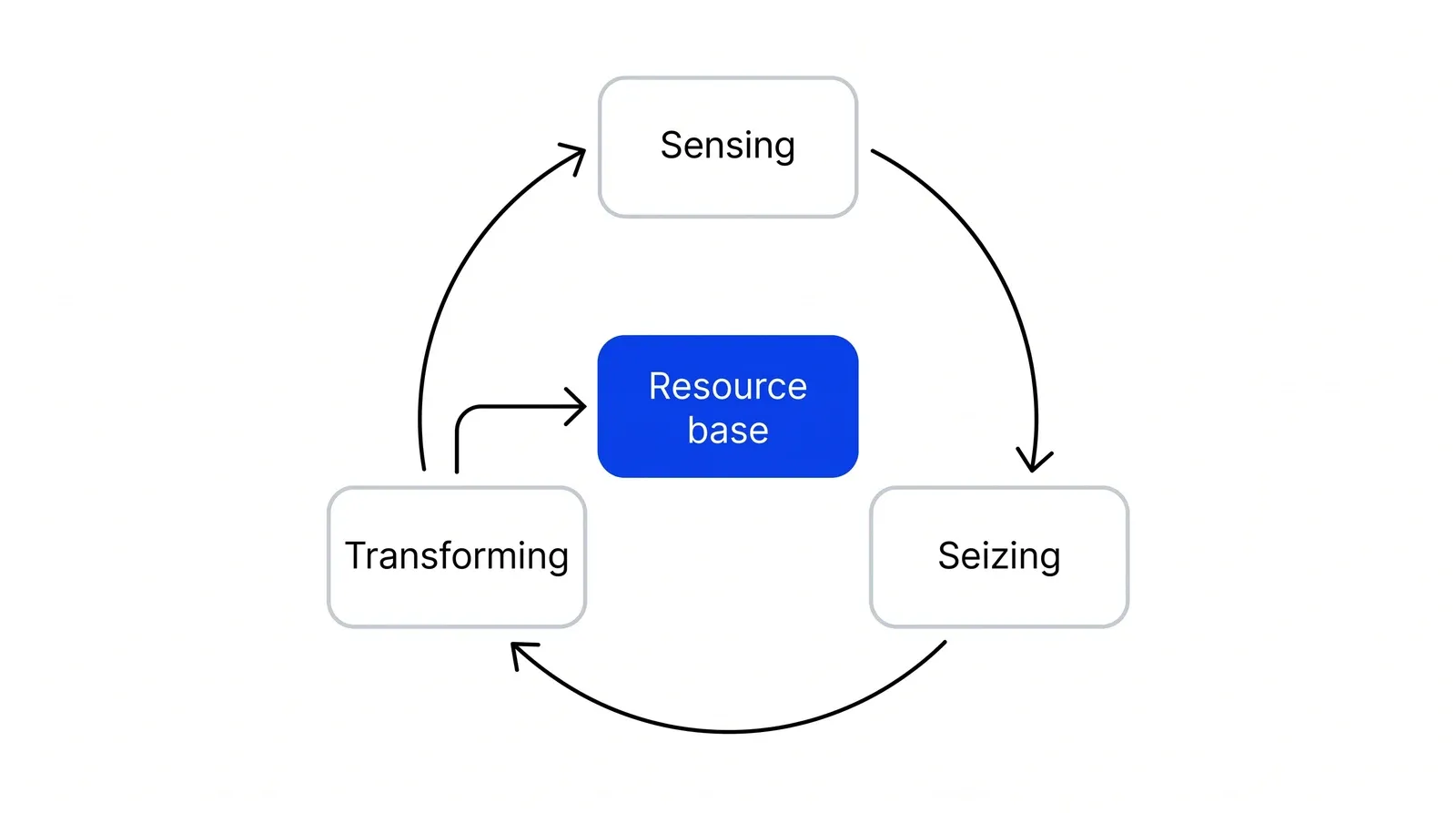
Sensing means spotting opportunities and threats, and sometimes shaping them. A payments firm that tracks central bank consultations on instant payments is sensing. Seizing means committing resources: choosing a business model, funding a project, signing partners. Transforming means changing the company itself, by recombining assets, moving budget and stopping old work.
Teece’s 2007 paper says the microfoundations of these activities are concrete: skills, procedures, organizational structures, decision rules. That is useful for a manager. You can audit each one.
Ordinary capabilities versus dynamic capabilities
Ordinary capabilities run today’s business. Sidney Winter’s 2003 paper defines them as the ones that let a firm “make a living” in the short term, and dynamic capabilities as those that extend, modify or create them.
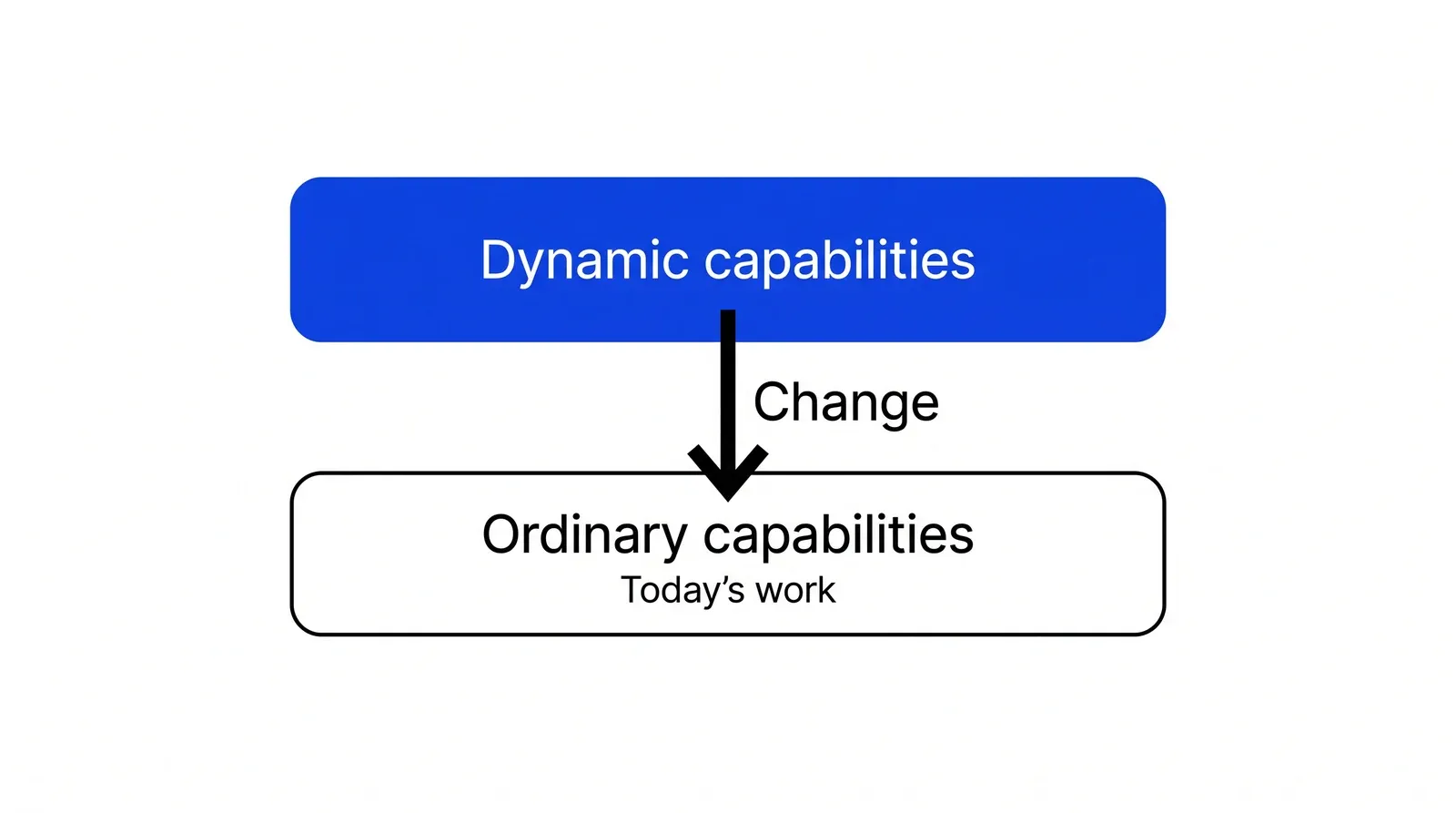
Winter adds two warnings. Building dynamic capabilities is costly, and a firm can also change through what he calls ad hoc problem solving, without any routine at all. Which path is cheaper depends on how often you face that kind of change. Helfat and Winter later wrote that the line between the two kinds is unavoidably blurry.
The hard part is that strong ordinary capabilities can block change. Dorothy Leonard-Barton called this the paradox of core capabilities and core rigidities: the skills and values that made you good also resist new products.
Two schools that disagree
The field has two founding papers, and they do not agree. Peteraf, Di Stefano and Verona describe them as holding contradictory understandings of the core idea.
| Question | Teece, Pisano and Shuen (1997), Teece (2007) | Eisenhardt and Martin (2000) |
|---|---|---|
| What are they? | Higher-order managerial and organizational capacities | Specific processes: product development, decisions, alliances |
| Are they unique? | Firm-specific and hard to copy | Similar across firms, close to best practice |
| Source of lasting edge? | Yes, they can underpin it | Less likely, because rivals can copy or substitute them |
| In fast markets | Stronger capabilities matter more | Simple, experiential, fragile processes |
Eisenhardt and Martin’s paper argues that dynamic capabilities are “specific and identifiable processes” and more substitutable than usually assumed. For a practitioner, both views help. Teece points at leadership and judgment. Eisenhardt and Martin point at processes you can copy from good practice, such as a disciplined acquisition playbook.
What it looks like in a real company
Two well-documented cases show sensing and transforming at work. Robert Burgelman’s study of Intel found that internal rules moved scarce manufacturing capacity from memory to microprocessors before top management formally changed strategy. The capability sat in a resource allocation routine.
Polaroid shows the opposite. Tripsas and Gavetti traced how managers’ beliefs about the business directed search and capability building during the move from analog to digital imaging. Their point is that what leaders believe about the business decides which new capabilities get built at all. A related pattern, incumbents struggling with a new kind of product, is the subject of disruptive innovation.
How do you build the capability on purpose? Zollo and Winter name three learning mechanisms: accumulating experience, articulating knowledge and codifying it. Their analysis suggests codifying works best for tasks that are rare and varied, such as acquisitions, the opposite of common practice.
The limits and the critics
The main criticism is vagueness. Barreto’s review notes a proliferation of definitions, and Arend and Bromiley list four major problems in logic, clarity and evidence. Schilke, Hu and Helfat’s 2018 review answers that empirical work has advanced considerably, though gaps remain. Ambrosini and Bowman add that dynamic capabilities do not automatically improve performance.
Change also has a price. Teece, Peteraf and Leih write that transformations come at a cost and are not always necessary. The practical reading: invest in change routines where your market moves, and pair the audit with scenario planning to decide which shifts deserve them. For Growth Lab work a sensible order is VRIO first, then an audit of how fast the company can sense, decide and reallocate.
How to apply Dynamic capabilities, step by step
- Name the shift. Write one sentence on the change you must answer and when it will bite: a new payment rail, a reimbursement rule, a cheaper technology. Keep it to one shift per audit. Result: a dated change statement the whole team agrees on.
- List what the shift threatens. Take your current strengths and mark which ones lose value if the shift happens. Leonard-Barton's warning applies: the strengths you are proudest of are often the ones that slow change. Result: a short list of ordinary capabilities at risk.
- Audit sensing. Ask who in the company watches for signals, which sources they read, and how a signal reaches the people who allocate money. Check the last five shifts: how many months passed between the first signal and the first leadership discussion? Result: a list of signal sources with owners, and the measured lag.
- Audit seizing. Trace how a sensed opportunity becomes a funded project: who decides, how budget is released outside the annual cycle, how a new business model is tested. Result: the time from signal to funded experiment, and the step where projects stall.
- Audit transforming. List what the company stopped, sold or moved resources away from in the last two years. If the list is empty, that is the finding. Name the structures, incentives or contracts that keep resources stuck. Result: a list of rigidities with an owner for each.
- Decide: build a routine or solve it once. If this kind of change repeats (new markets, acquisitions, product launches), write down how you do it and turn it into a routine, as Zollo and Winter suggest for rare, varied tasks. If it is a one-off, a dedicated team solving it ad hoc may be cheaper, as Winter argues. Result: two or three decisions with owners and a review date.
Examples
A cross-border payments company facing instant payment rails
Illustrative. A payments firm earns most of its margin on two-day bank transfers. Its sensing works: the product team flagged instant payment schemes three years ago. Seizing fails. Every proposal to build an instant product waits for the annual budget, and the sales team is paid on the old product's volume, so nobody pushes. The audit shows a 14-month gap between the first signal and the first funded prototype. The decisions: a quarterly fund for experiments that the CFO can release without the annual cycle, and a sales bonus that counts instant transfers at the same rate.
A clinic group adding remote consultations
Illustrative. A group of four clinics sees patients asking for video follow-ups. Front desk staff hear it every week, but the requests are never logged, so management does not know. Once sensing is fixed with a simple request log, seizing is quick: the group runs a pilot with two doctors. Transforming is the hard part. Room schedules, doctor pay and the booking system all assume a patient in a chair. The group gives one operations manager the job of changing those three things in order, with a date for each.
When to use it
Use dynamic capabilities thinking when your market is changing faster than your planning cycle: a new technology, a new regulator rule, a new type of competitor. It suits established companies that have strengths worth protecting and that must decide what to rebuild. It also works as a second step after a VRIO analysis, to ask whether the company can renew the advantages VRIO found.
When not to use it
Skip it for a startup still searching for product-market fit; the whole company is one experiment and the framework adds nothing. Do not use it in a stable market where change is slow and predictable; Teece and colleagues note that constant transformation has a cost and is not always needed. Do not use it as a label for 'being agile' without naming the specific processes you will change.
Common mistakes
- Using the term as a synonym for agility or innovation. A dynamic capability is a specific, repeatable way of changing the business, with owners and a record.
- Auditing only sensing. Most companies see the change coming; they fail at moving budget and stopping old work.
- Treating a one-time turnaround as a capability. A capability shows up the second and third time, not once.
- Ignoring the cost. Winter (2003) points out that building change routines costs money, and ad hoc problem solving can be the cheaper choice.
- Assuming the process itself is the edge. Eisenhardt and Martin argue good practices for product development or alliances look similar across firms, so the process alone rarely sets you apart.
FAQ
What are dynamic capabilities in simple terms?
Dynamic capabilities are a company's ability to change itself when its market changes: to notice new opportunities and threats, commit money and people to them, and rebuild its resources and processes. Teece, Pisano and Shuen's 1997 paper defined them as the ability to integrate, build and reconfigure internal and external competences in a fast-changing environment.
What are sensing, seizing and transforming?
They are the three groups of activity David Teece used in a 2007 paper to break dynamic capabilities down. Sensing is spotting and shaping opportunities and threats. Seizing is committing resources and a business model to them. Transforming, which Teece first called reconfiguring, is renewing and recombining the company's assets so it stays competitive.
What is the difference between ordinary and dynamic capabilities?
Ordinary capabilities let a company make a living today: running payroll, shipping orders, treating patients. Dynamic capabilities change those ordinary capabilities. Sidney Winter described this as a hierarchy in a 2003 paper. Helfat and Winter later added that the line between the two is blurry in practice, because some routines both run and slowly change the business.
What are examples of dynamic capabilities?
Eisenhardt and Martin list product development, strategic decision making and alliancing. A documented case is Intel in the 1980s: Robert Burgelman's 1994 study shows how its internal rules moved scarce manufacturing capacity from memory chips to microprocessors before top management formally changed the strategy. Acquisition integration routines are another common example.
How do dynamic capabilities relate to the resource-based view and VRIO?
The resource-based view and VRIO test whether a company's current resources give it an edge. Dynamic capabilities ask how those resources get created and refreshed when markets shift. Ambrosini and Bowman describe the dynamic view as an extension of the resource-based view for exactly that question.
Sources
- David J. Teece, Gary Pisano, Amy Shuen, Dynamic Capabilities and Strategic Management, Strategic Management Journal 18(7), 1997
- David J. Teece, Gary Pisano, The Dynamic Capabilities of Firms: an Introduction, Industrial and Corporate Change 3(3), 1994
- David J. Teece, Explicating Dynamic Capabilities: The Nature and Microfoundations of (Sustainable) Enterprise Performance, Strategic Management Journal 28(13), 2007
- David J. Teece, The Foundations of Enterprise Performance: Dynamic and Ordinary Capabilities in an (Economic) Theory of Firms, Academy of Management Perspectives 28(4), 2014
- David J. Teece, Margaret Peteraf, Sohvi Leih, Dynamic Capabilities and Organizational Agility, California Management Review 58(4), 2016
- David J. Teece, Business Models and Dynamic Capabilities, Long Range Planning 51(1), 2018
- David J. Teece, Dynamic Capabilities as (Workable) Management Systems Theory, Journal of Management & Organization 24(3), 2018
- David J. Teece, Dynamic Capabilities (author's research page)
- California Management Review, Amanda Wong, The Key to Keeping Up: Dynamic Capabilities, 2016
- Kathleen M. Eisenhardt, Jeffrey A. Martin, Dynamic Capabilities: What Are They?, Strategic Management Journal 21(10-11), 2000
- Margaret A. Peteraf, Giada Di Stefano, Gianmario Verona, The Elephant in the Room of Dynamic Capabilities, Strategic Management Journal 34(12), 2013
- Giada Di Stefano, Margaret Peteraf, Gianmario Verona, Dynamic Capabilities Deconstructed, Industrial and Corporate Change 19(4), 2010
- Sidney G. Winter, Understanding Dynamic Capabilities, Strategic Management Journal 24(10), 2003
- Constance E. Helfat, Sidney G. Winter, Untangling Dynamic and Operational Capabilities, Strategic Management Journal 32(11), 2011
- Maurizio Zollo, Sidney G. Winter, Deliberate Learning and the Evolution of Dynamic Capabilities, Organization Science 13(3), 2002
- Constance E. Helfat, Margaret A. Peteraf, The Dynamic Resource-Based View: Capability Lifecycles, Strategic Management Journal 24(10), 2003
- Constance E. Helfat et al., Dynamic Capabilities: Understanding Strategic Change in Organizations, Blackwell, 2007
- Véronique Ambrosini, Cliff Bowman, What Are Dynamic Capabilities and Are They a Useful Construct in Strategic Management?, International Journal of Management Reviews 11(1), 2009
- Ilídio Barreto, Dynamic Capabilities: A Review of Past Research and an Agenda for the Future, Journal of Management 36(1), 2010
- Catherine L. Wang, Pervaiz K. Ahmed, Dynamic Capabilities: A Review and Research Agenda, International Journal of Management Reviews 9(1), 2007
- Richard J. Arend, Philip Bromiley, Assessing the Dynamic Capabilities View: Spare Change, Everyone?, Strategic Organization 7(1), 2009
- Oliver Schilke, Songcui Hu, Constance E. Helfat, Quo Vadis, Dynamic Capabilities?, Academy of Management Annals 12(1), 2018
- Shaker A. Zahra, Harry J. Sapienza, Per Davidsson, Entrepreneurship and Dynamic Capabilities, Journal of Management Studies 43(4), 2006
- Robert A. Burgelman, Fading Memories: A Process Theory of Strategic Business Exit in Dynamic Environments, Administrative Science Quarterly 39(1), 1994 (Stanford GSB)
- Mary Tripsas, Giovanni Gavetti, Capabilities, Cognition, and Inertia: Evidence from Digital Imaging, Strategic Management Journal 21(10-11), 2000
- Dorothy Leonard-Barton, Core Capabilities and Core Rigidities, Strategic Management Journal 13(S1), 1992
- Charles A. O'Reilly, Michael L. Tushman, Ambidexterity as a Dynamic Capability: Resolving the Innovator's Dilemma, Research in Organizational Behavior 28, 2008
- Charles A. O'Reilly, Michael L. Tushman, The Ambidextrous Organization, Harvard Business Review, April 2004
- Jay B. Barney, Firm Resources and Sustained Competitive Advantage, Journal of Management 17(1), 1991
Last updated Oct 9, 2026


Marketing agency or growth system: when a company outgrows its agency
An agency is the right call while the founder still runs most of the company. Once the business starts copying itself into new locations or markets, it needs a system that sets goals, tests hypotheses and owns the result.

Why healthcare marketing agencies stall: the short, mid and long wins model we use with clinics
Most agencies own the click and nobody owns the front desk. How we structure clinic work in three horizons, the research behind each one, and one year of results.

Why channel tests stall after month three
Most paid channel tests do not end with a decision. They end when the budget runs out, the attribution model changes, or everyone quietly stops looking at the dashboard.