Ideal customer profile (ICP)
An ideal customer profile describes the type of company that gets the most value from your product and returns the most value to you, so sales and marketing know which accounts to chase and which to drop.
An ideal customer profile (ICP) is a short description of the type of company that buys from you, stays and pays at a healthy margin. B2B teams build it from their best existing accounts using firmographics, technographics and buying triggers, then use it to decide which accounts sales and marketing pursue. A buyer persona describes the people inside those companies.
- Origin
- B2B sales and marketing practice, no single inventor; roots in industrial market segmentation (Shapiro and Bonoma), No agreed date; nested segmentation model 1983 to 1984
- Level
- 201 · Tool
- Fits
- Startup, Small and mid-size, Scale-up
- Time to apply
- two to three weeks for a first version: a week of CRM analysis, a week of customer interviews, a session to write it down
- What you need
- two or three years of closed-won, lost and churned accounts from the CRM, with revenue and gross margin per account · 8 to 10 interviews with your best customers · one owner from sales and one from marketing who will both use the result
An ideal customer profile (ICP) is a description of the type of company that gets the most value from your product and gives the most value back: it buys, renews and pays at a healthy margin. Sales uses it to decide which accounts to call. Marketing uses it to decide whom to target and which leads to pass on. Customer success uses it to spot accounts that will need more help than they pay for.
Nobody invented the ICP. The term grew out of B2B sales and marketing practice, and vendors such as Salesforce and HubSpot now publish their own templates. Its roots are in industrial market segmentation. In Harvard Business Review in 1984, Benson Shapiro and Thomas Bonoma set out a nested model for dividing business markets. As Art Weinstein summarizes it, the nests run from geodemographics and operating variables on the outside to purchasing approaches, situational factors and the characteristics of the buyer inside. An ICP takes the outer layers and turns them into a filter for accounts.
What goes into an ideal customer profile?
An ICP has three parts: who the company is, what it runs and what situation makes it buy. Most teams add a fourth, the disqualifiers.
| Part | What it covers | Example attributes |
|---|---|---|
| Firmographics | Facts about the company | Industry, headcount, revenue band, country, growth stage |
| Technographics | The technology it already uses | CRM, payment provider, cloud platform, a competitor’s product |
| Triggers | Events that start a purchase | New funding, a new regulation, a merger, a new head of finance |
| Disqualifiers | Signs the account will cost more than it pays | Too small to afford the product, high support load, wrong country |
Firmographics are to companies what demographics are to people. The Salesforce definition lists company size, industry, revenue, employee count and growth potential. Technographics describe the software, hardware and digital tools a company runs. The word comes from Forrester, where Technographics is the trademarked name of a consumer survey; its 2005 North American benchmark covered 68,664 households. In B2B work the term now means a company’s tech stack, and it matters because the tools a company already runs decide how hard your product is to adopt.
Triggers come from customer interviews; databases rarely show them. A company that fits every firmographic rule may still have no reason to buy this year.
How do you find your best customers?
Start from value, not from size or fame. The largest logos are often the most expensive to serve, and loyal customers are not automatically profitable. Werner Reinartz and V. Kumar questioned that assumption in Harvard Business Review in 2002, against the common belief that the best customers are the loyal ones.
Selecting customers by expected value works better than selecting them by past behavior. Rajkumar Venkatesan and V. Kumar found in the Journal of Marketing (2004) that customers chosen on lifetime value gave higher profits in later periods than customers chosen on several other customer metrics.
A worked example, illustrative only. A B2B payments provider has 120 merchant clients. Ranked by gross profit after support and dispute handling, the top 24 accounts produce well over half of the total. The bottom 24 lose money once their support tickets and chargebacks are counted. Compare the two lists and a pattern appears: 19 of the top 24 are online sellers with 50 to 500 staff and more than a third of revenue from abroad. Most of the bottom 24 are small domestic marketplaces with high dispute rates. That comparison is the first draft of the ICP, and the dispute rate becomes a disqualifier.
Fit versus intent
Fit tells you whether an account looks like your best customers. Intent tells you whether it is shopping now. An ICP measures fit. Intent data adds timing.
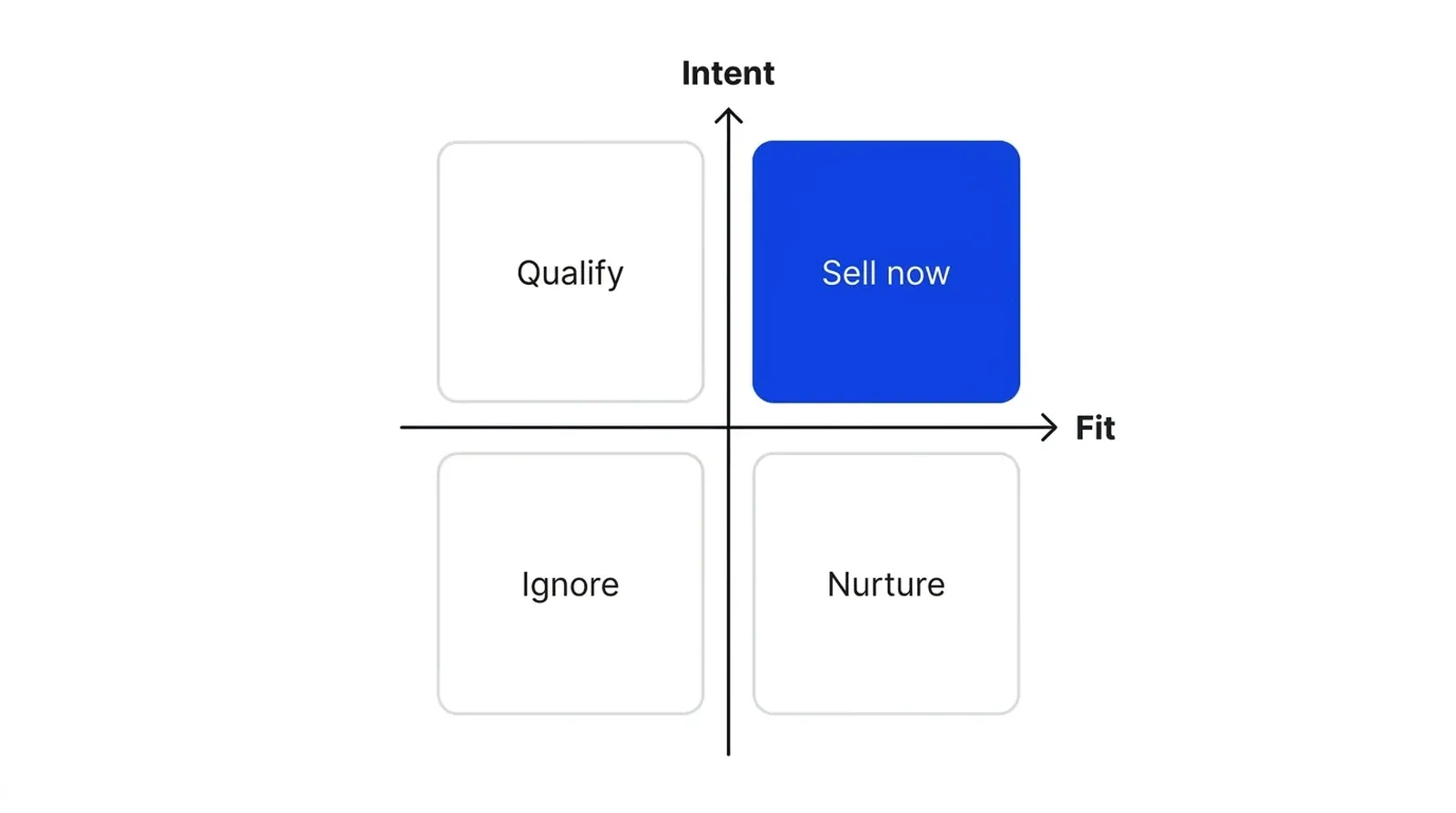
Tools split the two the same way. HubSpot’s lead scoring keeps fit scores, based on properties such as job title, company size or annual revenue, apart from engagement scores, based on actions such as site visits and email opens, and only engagement scores decay over time. 6sense scores account profile fit by comparing an account with past won deals, and scores intent as the likelihood that an account is interested in buying.
Third-party intent comes from research activity outside your site. Bombora compares an account’s last three weeks of activity with a 12-week baseline to flag a surge. G2’s buyer intent data records when a company views your profile, pricing, comparison or alternatives pages.
The two signals do not simply add up. Forrester analyst Nora Conklin wrote in 2023 that the relationship between fit and intent is not linear, and that high-fit accounts deserve reputation building even when they are not in a buying cycle. That is the bottom-right box in the grid: nurture them, because they will buy from someone eventually.
ICP versus buyer persona
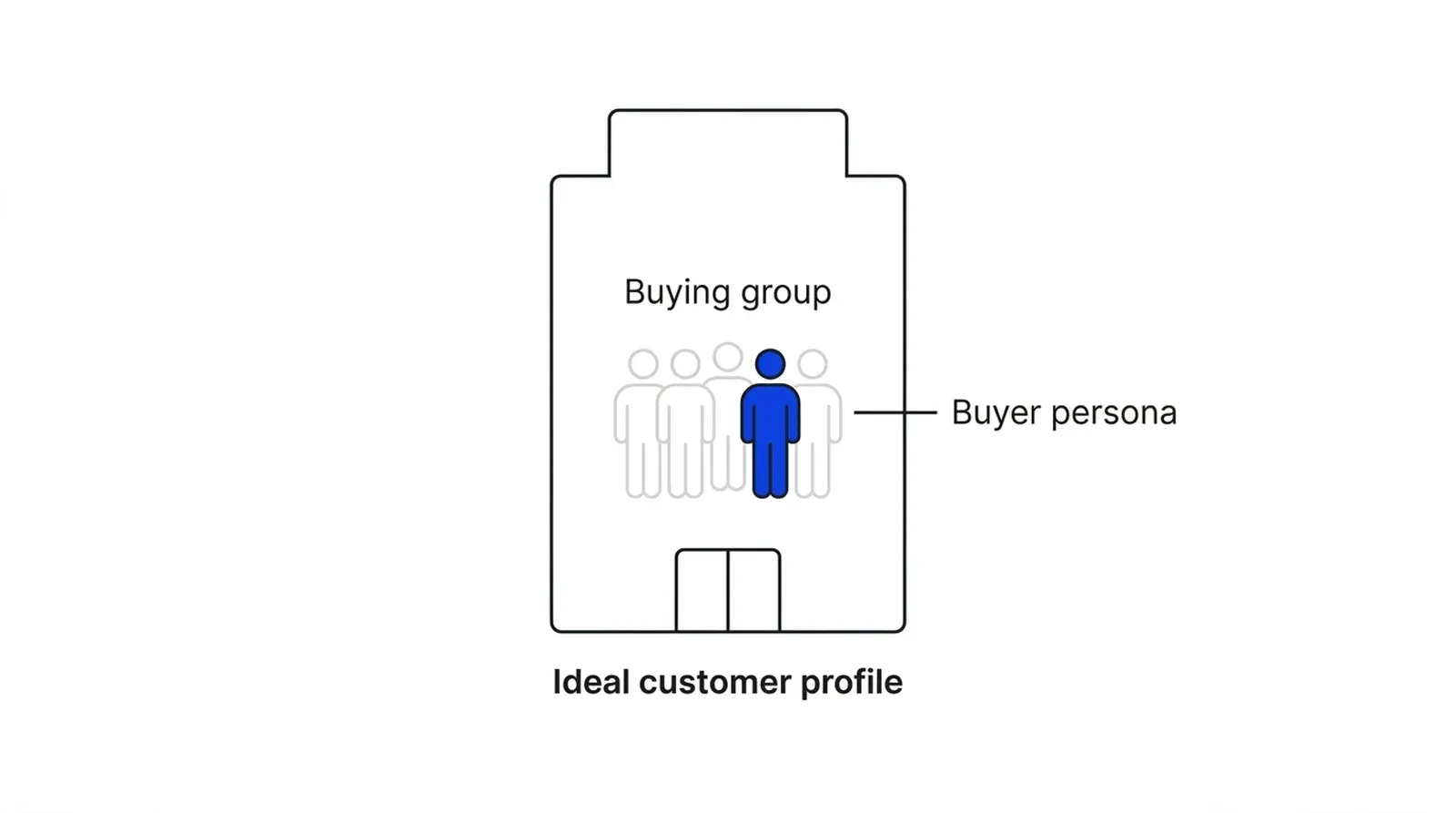
An ICP describes a company; a buyer persona describes a person inside it. HubSpot and Salesforce draw the line the same way. Not every vendor does: Demandbase calls an ICP an actual prospect with a specific job title or company, which mixes the two. Keep them apart, because you need different data to build each.
| Ideal customer profile | Buyer persona | |
|---|---|---|
| Describes | A type of company | A type of person in the buying group |
| Built from | CRM data on won, lost and churned accounts | Interviews with buyers |
| Main attributes | Firmographics, technographics, triggers | Role, goals, worries, decision criteria |
| Decides | Which accounts to pursue | What to say and to whom |
Personas came from software design. Alan Cooper dates his first persona to 1983, when he based a design on Kathy, who handled traffic at an advertising agency. John Pruitt and Jonathan Grudin extended the method in 2003. Marketers later adapted it; the Buyer Persona Institute builds personas from the real words of real buyers.
B2B purchases involve many people, which is why one ICP usually needs several personas. Frederick Webster and Yoram Wind modeled organizational buying as a group decision process in 1972. Forrester’s 2024 State of Business Buying puts the average at 13 people per purchase, with 89% of purchases involving two or more departments. Personal motives count too: Bain partners writing in HBR in 2018 found that buyers’ subjective, sometimes personal considerations are increasingly important in business purchases.
Why it pays to be narrow
Buyers punish poor targeting. A Gartner survey of 632 B2B buyers, published in June 2025, found that 73% actively avoid suppliers who send irrelevant outreach. A clear ICP is the cheapest way to stop sending it.
Narrow targeting also moves money to where it earns most, as the IBM customer lifetime value pilot and the chemicals micromarket case in the examples below show. The ICP is the input for account-based marketing, which turns the profile into a named list of accounts. In Pushers’ Growth Lab work, the ICP comes before any channel plan, because channels are chosen by where those accounts can be reached.
How to apply Ideal customer profile (ICP), step by step
- Define what best means. Agree on the outcome that makes a customer ideal before looking at any data: gross margin over two years, retention past the first renewal, expansion revenue, or a mix. Revenue alone flatters large accounts that cost a lot to serve. Result: one written definition of a best customer that sales and finance both accept.
- Rank your accounts by that outcome. Export every account won in the last two to three years, add churned ones, and sort them by the outcome you chose. Mark the top fifth and the bottom fifth. Result: two lists of accounts, the ones you want more of and the ones you want fewer of.
- Compare the two groups on firmographics and technographics. For each list, count industry, headcount, revenue band, country, growth stage and the software each company runs. Look for attributes that are common at the top and rare at the bottom. Result: three to six attributes that separate good accounts from bad ones, plus any clear disqualifiers.
- Interview the best customers about the trigger. Ask 8 to 10 top accounts what happened inside the company just before they started looking, who was involved and what nearly stopped the deal. Firmographics say who could buy; the trigger says when. Result: a short list of buying triggers and the roles in the buying group.
- Write the ICP and score accounts against it. Put must-have attributes, nice-to-have attributes, triggers and disqualifiers on one page. Turn the must-haves into a fit score in the CRM so every new account is rated the same way. Result: a one-page ICP and a fit field on every account record.
- Add intent signals and review every quarter. Layer intent data, such as website visits or third-party research spikes, on top of fit to decide timing. Each quarter, check whether the accounts that scored high on fit closed and stayed. Result: an ICP that changes when the evidence does.
Examples
IBM selects customers by lifetime value
V. Kumar and colleagues described in Marketing Science (2008) how IBM used customer lifetime value, instead of past spending, to decide how much direct mail, telesales, email and catalog contact each business customer received. In a pilot covering about 35,000 customers, the new rule moved resources for about 14% of them. The authors report a revenue increase of about $20 million with no change in marketing investment. The logic is the same as an ICP: rank accounts by future value, then spend where that value is.
A chemicals company splits seven regions into 70 micromarkets
Manish Goyal, Maryanne Hancock and Homayoun Hatami of McKinsey describe in Harvard Business Review (2012) a global chemicals and services company whose sales volume had stalled. It divided its seven US sales regions into 70 micromarkets, found the ones with the most potential, moved reps out of overserved territories and wrote sales plays for the new targets. Within a year its sales growth rate doubled without higher marketing or sales costs.
A clinic software vendor narrows its target
Illustrative, no real company implied. A vendor of booking and billing software for private clinics has 200 clients. Ranking them by two-year gross margin shows that the top 40 are multi-site dental and dermatology groups with 3 to 15 locations that already use an online payment provider. The bottom 40 are single-doctor practices that need heavy onboarding and leave within a year. The ICP becomes clinic groups with 3 to 15 sites and online payments in place, and single-site practices move to a self-serve plan.
When to use it
Use an ICP when sales cycles are long and each deal takes real effort, when marketing generates leads that sales ignores, when churn is concentrated in one type of customer, or before starting account-based marketing, which depends on a target account list. It also helps when a company enters a new market and has to decide which companies to approach first.
When not to use it
It adds little for a consumer business selling to individuals, where buyer personas and segmentation do the job. With fewer than about ten paying customers there is not enough data to see a pattern, so treat any early ICP as a hypothesis to test, not a filter that rejects leads.
Common mistakes
- Building the ICP from the biggest logos instead of the most profitable and loyal accounts, so the profile describes customers that look good on a slide and cost a lot to serve.
- Writing it from opinions in a workshop without pulling the CRM data, which produces a description of the customer the team wishes it had.
- Mixing the account and the person, so the ICP lists job titles and pain points that belong in buyer personas.
- Treating intent as a replacement for fit, and sending sales after every company that visited the pricing page even when it is too small or in the wrong industry to buy.
- Never revisiting it. A profile written for the first 50 customers rarely fits the next 500.
FAQ
What is an ideal customer profile in B2B?
It is a description of the type of company that is the best fit for what you sell: the industry, size, location, technology and situation of accounts that buy, stay and are profitable. It is built from your own best customers and used to decide which accounts sales and marketing should spend time on.
What is the difference between an ICP and a buyer persona?
An ICP describes a company; a buyer persona describes a person inside it. HubSpot and Salesforce both draw the line this way: the ICP decides which accounts to pursue, the persona shapes how to talk to the people who buy there. Most B2B teams need one ICP and several personas, because a purchase involves many people.
What are firmographics and technographics?
Firmographics are facts about a company, such as industry, headcount, revenue, location and growth stage. Technographics are facts about the technology it runs, such as its CRM, payment provider or cloud platform. Together they form the fit part of an ICP. The word Technographics began as the name of a Forrester consumer survey.
What is the difference between fit and intent?
Fit says whether an account looks like your best customers; intent says whether it is researching a purchase now. Fit changes slowly and comes from firmographic and technographic data. Intent changes week to week and comes from behavior such as site visits or third-party research spikes. Forrester argues the two must be read together, not added up.
How many ideal customer profiles should a company have?
Usually one per product line or market, and few companies need more than two or three. Each extra ICP needs its own messages, sales plays and content, so a small team with four profiles ends up serving none of them well. If two profiles share most attributes, merge them.
Sources
- Benson P. Shapiro, Thomas V. Bonoma, How to Segment Industrial Markets, Harvard Business Review, May 1984
- Art Weinstein, Segmenting technology markets: applying the nested approach, Marketing Intelligence & Planning 29(7), 2011
- Frederick E. Webster, Yoram Wind, A General Model for Understanding Organizational Buying Behavior, Journal of Marketing 36(2), 1972
- Rajkumar Venkatesan, V. Kumar, A Customer Lifetime Value Framework for Customer Selection and Resource Allocation Strategy, Journal of Marketing 68(4), 2004
- V. Kumar, Rajkumar Venkatesan, Timothy Bohling, Denise Beckmann, The Power of CLV: Managing Customer Lifetime Value at IBM, Marketing Science 27(4), 2008
- Werner Reinartz, V. Kumar, The Mismanagement of Customer Loyalty, Harvard Business Review, July 2002
- Manish Goyal, Maryanne Q. Hancock, Homayoun Hatami, Selling into Micromarkets, Harvard Business Review, July-August 2012
- Eric Almquist, Jamie Cleghorn, Lori Sherer, The B2B Elements of Value, Harvard Business Review, March-April 2018
- Forrester, Nora Conklin, Fit And Intent Are Not Silver Bullets, May 2023
- Forrester, The State of Business Buying 2024, press release, December 2024
- Forrester, The State of Consumer Technology Adoption (Consumer Technographics benchmark), press release, August 2005
- Gartner, Gartner Sales Survey Finds 61% of B2B Buyers Prefer a Rep-Free Buying Experience, press release, June 2025
- Salesforce, What Is an Ideal Customer Profile (ICP)?
- HubSpot, Ideal Customer Profile Template
- HubSpot Knowledge Base, Understand the lead scoring tool (fit, engagement and combined scores)
- Demandbase, What is an Ideal Customer Profile (ICP)?
- 6sense Support, Predictive models (profile fit and intent)
- Bombora, Company Surge intent data
- G2 Documentation, Buyer Intent data reference
- Alan Cooper, The Origin of Personas, Cooper Journal, August 2003 (Internet Archive copy)
- John Pruitt, Jonathan Grudin, Personas: Practice and Theory, Proceedings of DUX 2003, ACM
- Buyer Persona Institute, Buyer persona research
Last updated Oct 9, 2026


Marketing agency or growth system: when a company outgrows its agency
An agency is the right call while the founder still runs most of the company. Once the business starts copying itself into new locations or markets, it needs a system that sets goals, tests hypotheses and owns the result.

Why healthcare marketing agencies stall: the short, mid and long wins model we use with clinics
Most agencies own the click and nobody owns the front desk. How we structure clinic work in three horizons, the research behind each one, and one year of results.

The compliance layer under fintech marketing operations
A fintech marketing agency can build campaigns. It cannot own the compliance review, the KYC drop-off or the multi-market licensing rules that decide whether a lead ever becomes a customer.